Telescope & Optics Tools
Explore 5 fascinating articles about telescope & optics tools
Compute magnification, light gathering power, and field of view. Optimize your optical configurations and telescope setup.
All Articles (5)
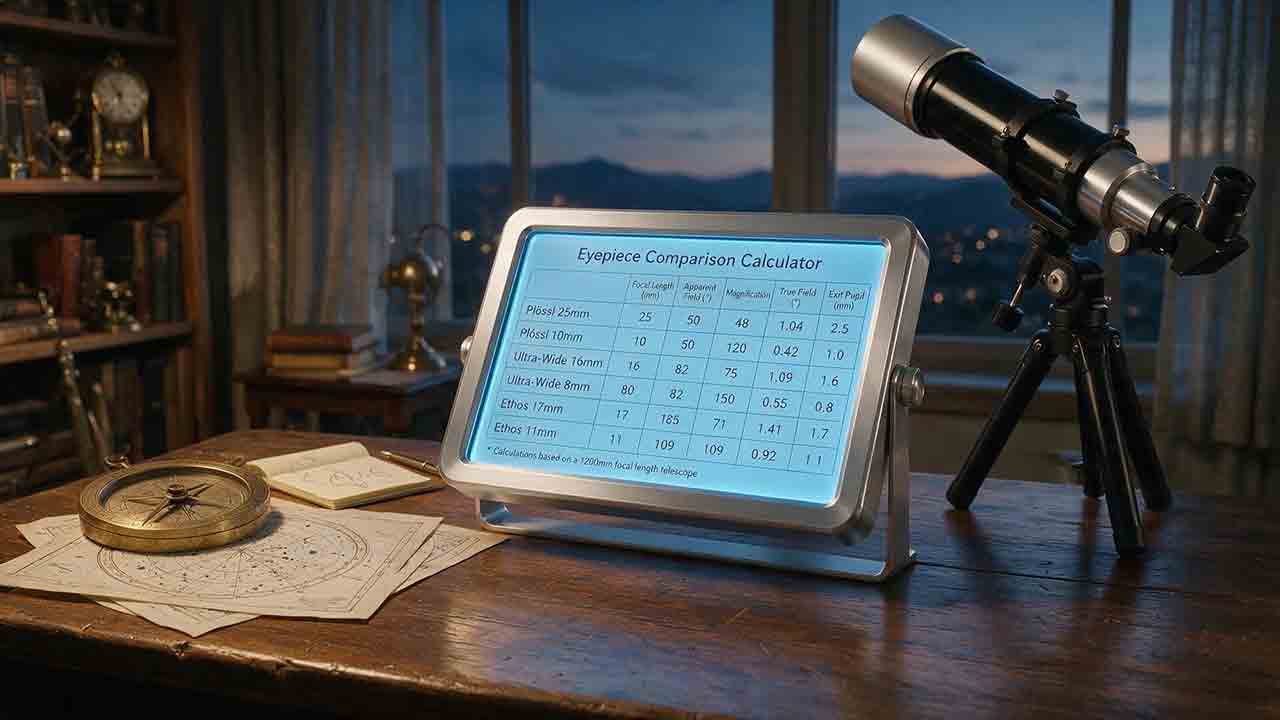
Eyepiece Comparison Calculator
This guide explains how to compare up to four telescope eyepieces using magnification, exit pupil, true field, sky coverage, eye relief, weight, and observer-pupil matching. It defines a reference-eyepiece method so every ratio and percentage has a clear direction, prioritizes field-stop-based true field when reliable data is available, and warns when AFOV and field-stop estimates differ or when mixed calculation methods are used. The article adds the original Four-Dimension Eyepiece Role Map, a reproducible same-field-stop example, pupil-adjusted brightness calculations, weight conversion rules, compatibility reminders, and a transparent field-method warning threshold. Readers can identify meaningful role differences, evaluate possible overlap, and understand what calculations cannot reveal, including optical quality, comfort, mechanical safety, and real-world compatibility. The guidance is based on published specifications and authoritative references rather than product testing or universal rankings.
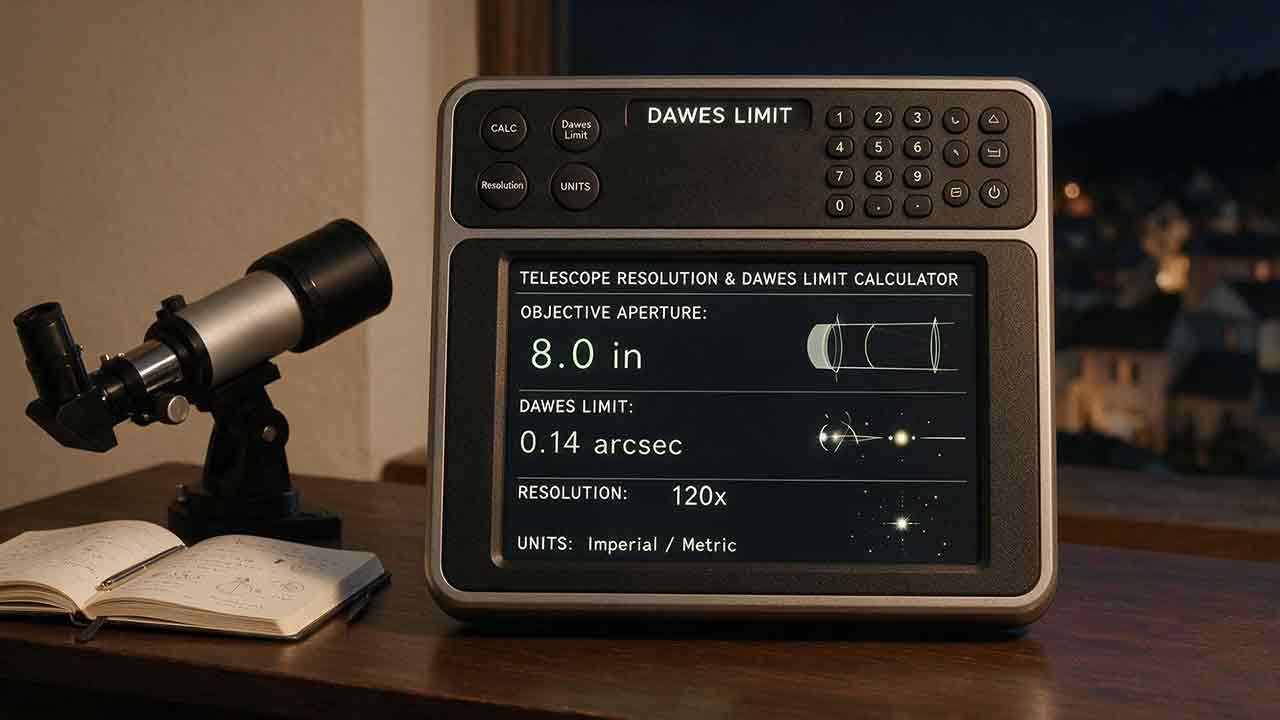
Telescope Resolution and Dawes Limit Calculator
This guide explains how to calculate and interpret telescope resolution using Dawes’ limit and the Rayleigh criterion. It separates empirical visual double-star thresholds from wavelength-dependent diffraction, clarifies why the Rayleigh angle and Airy first-minimum radius share the same numerical value in the ideal circular-aperture model, and shows how aperture, wavelength, seeing, central obstruction, magnification, pixel scale, and target contrast affect practical results. Readers can compare double-star separation with both criteria, convert inches to millimeters safely, evaluate seeing with a published ratio, translate angular values into reference linear scales, and use upward rounding for required-aperture thresholds. Original tools such as the Resolution Reality Stack and separately named separation ratios help prevent theoretical limits from being mistaken for guaranteed observing or imaging performance. The article also includes worked examples, derived aperture data, troubleshooting guidance, solar-observing safety, and clearly documented calculation assumptions.
Telescope Exit Pupil Calculator
This guide explains how to calculate telescope exit pupil from either aperture and magnification or eyepiece focal length and effective focal ratio. It separates manual and specification-derived magnification paths, publishes an unrounded consistency tolerance, and shows how to interpret disagreements without silently replacing or averaging inputs. Readers can compare practical exit-pupil ranges, estimate pupil-limited outer aperture, understand the limits of unobstructed light-fraction calculations, and account for central obstruction and observer-pupil uncertainty. Original planning tools include the Same-Pupil Comparison Rule, the Pupil Match Audit, boundary-handling rules, a focal-ratio reference table, and a sensitivity table for oversized exit pupils. Worked examples, troubleshooting guidance, equipment checks, and solar-observing safety notes help observers choose eyepieces while avoiding exaggerated claims about resolution, brightness, compatibility, or useful magnification.
Telescope Field of View Calculator
This guide explains how to calculate telescope field of view for visual eyepieces, camera sensors, and drift-timing measurements. It separates AFOV-based estimates, field-stop calculations, geometric camera formulas, and empirical drift checks so readers can choose the correct method and avoid mixing incompatible inputs. Worked examples, a derived field-stop reference table, and the original Field Fit Ratio framework show how to judge whether a target will fit with practical framing margin. The Three-Field Reality Check distinguishes calculated angular coverage from fully illuminated and optically usable field, helping readers account for vignetting, edge aberrations, spacing, sensor rotation, and accessory compatibility. The article also documents input validation, precision, rounding, high-declination drift limits, troubleshooting steps, planning checklists, and solar-observing safety. It is based on authoritative documentation and reproducible calculations rather than product testing or unsupported performance claims.
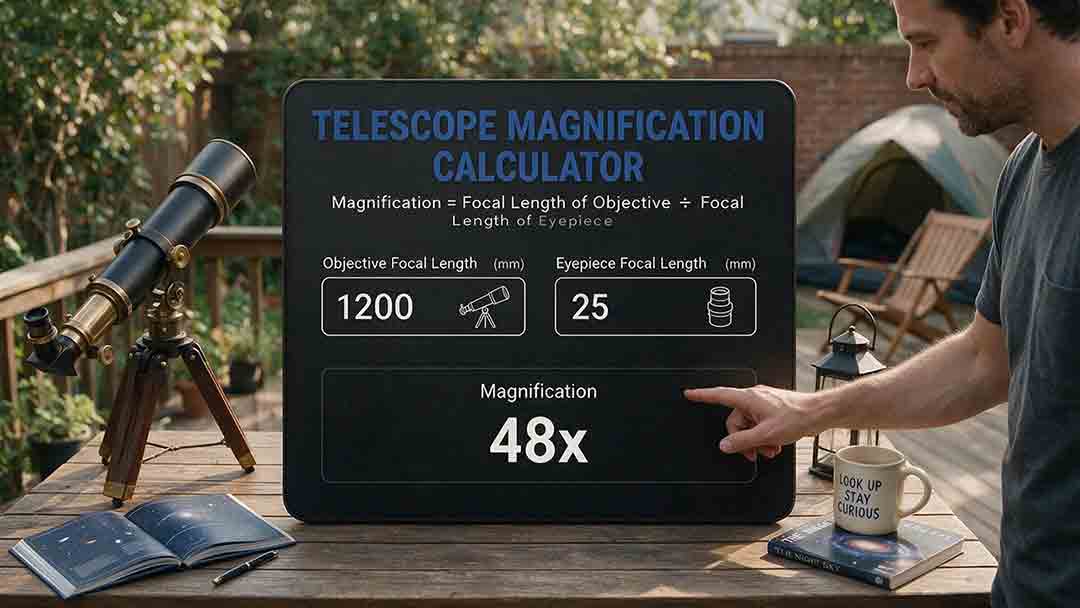
Telescope Magnification Calculator
This guide explains how to calculate telescope magnification from effective telescope focal length, eyepiece focal length, and any Barlow, extender, reducer, or corrector multiplier. It also shows how aperture changes exit pupil, effective focal ratio, and magnification per inch, and how apparent field or field-stop data can estimate true field of view. Transparent input dependencies, category boundaries, unrounded classification rules, and worked examples make every result reproducible. The article distinguishes calculated, nominal, actual, and useful observing magnification, including the effects of accessory spacing and moving-primary telescope designs. Its original Four-Gate Useful-Power Audit helps readers judge field coverage, atmospheric stability, optical readiness, and information gain before increasing magnification. Practical tables, target-based recommendations, troubleshooting guidance, eyepiece planning checks, compatibility limits, and solar-viewing safety notes help readers choose and interpret magnification without treating mathematical results as guaranteed performance or product recommendations.