Sky & Time Tools
Explore 5 fascinating articles about sky & time tools
Track celestial coordinates, sidereal time, and moon phases. Plan your stargazing sessions with precise astronomical calendars.
All Articles (5)
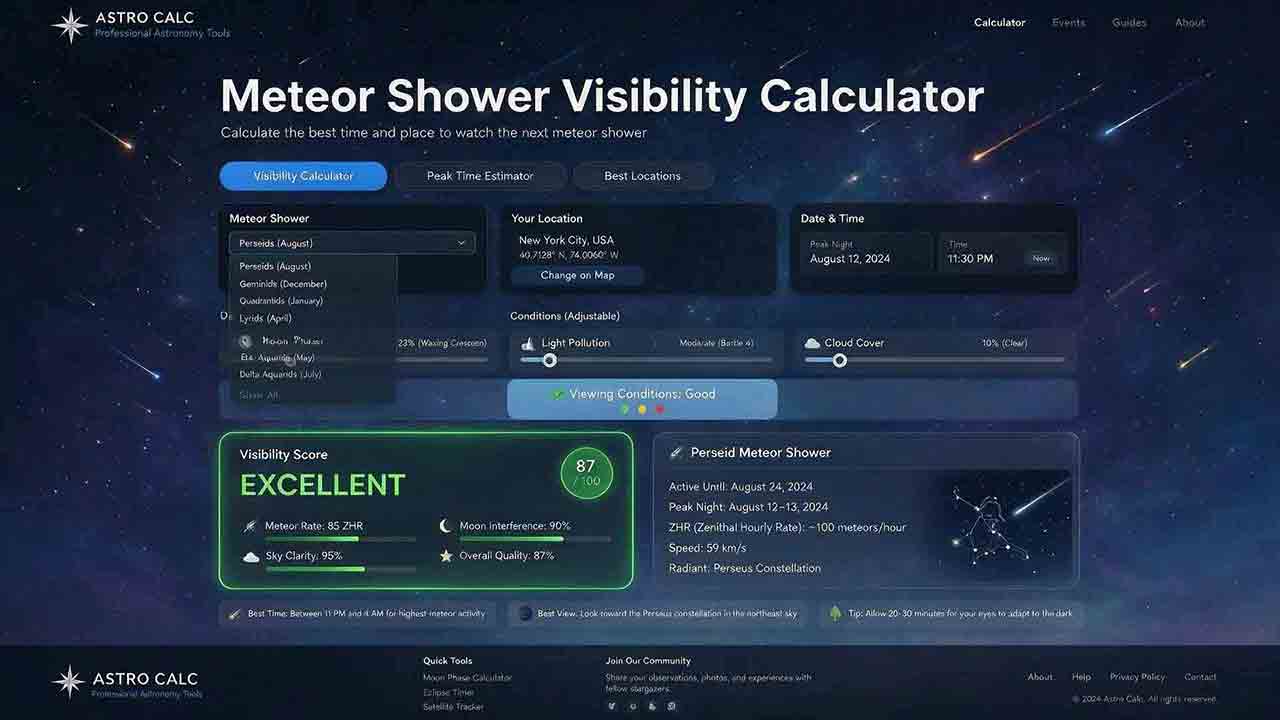
Meteor Shower Visibility Calculator
This guide explains how to use a meteor shower visibility calculator to identify a locally favorable observing window instead of relying only on a published peak time or Zenithal Hourly Rate. It covers activity periods, radiant altitude, astronomical darkness, Moon timing, weather, limiting magnitude, population index, and the distinction between named-shower members, sporadic meteors, and meteors from overlapping showers. The article introduces two original planning tools: the Five-Layer Meteor Test and the Meteor Opportunity Window, which calculates the overlap between activity, radiant, darkness, Moon, weather, and session constraints. A reproducible cross-midnight example compares illustrative 20° and 40° radiant thresholds, producing windows of 2 hours 20 minutes and 1 hour 40 minutes. Practical guidance addresses moonlight, viewing direction, dark adaptation, calculator disagreements, troubleshooting, and responsible site selection, supported by NASA, IMO, AMS, and U.S. Naval Observatory sources.
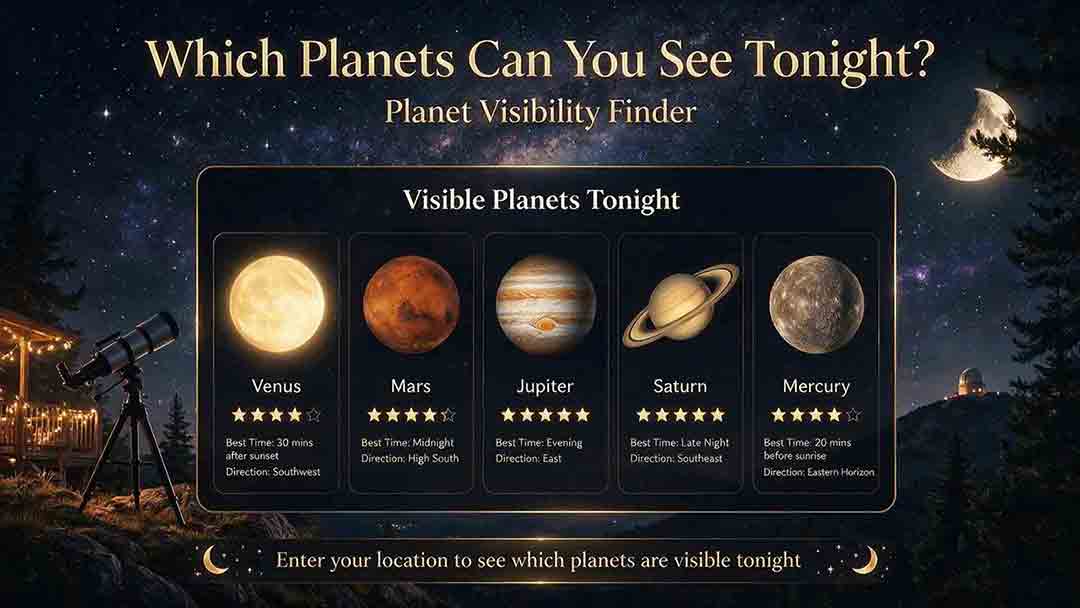
Planet Visibility Finder: Which Planets Can You See Tonight?
This guide explains how to use a planet visibility finder to decide which planets are realistically observable for a selected date, time, and location. It shows why an object being above the horizon does not guarantee visibility and explains the roles of altitude, azimuth, apparent magnitude, solar elongation, twilight, moonlight, weather, and local obstructions. Readers learn which planets are normally visible without a telescope, how Mercury and Venus differ from the outer planets, and why two finders may produce different results. The article introduces an original Four-Gate Visibility Test covering position, solar light, detectability, and site timing, plus a reproducible Useful Viewing Window calculation. A hypothetical example compares a 1-hour-26-minute naked-eye window with an 18-minute higher-altitude telescope window. Practical troubleshooting, safety guidance, and NASA, USNO, and JPL sources support the planning method.
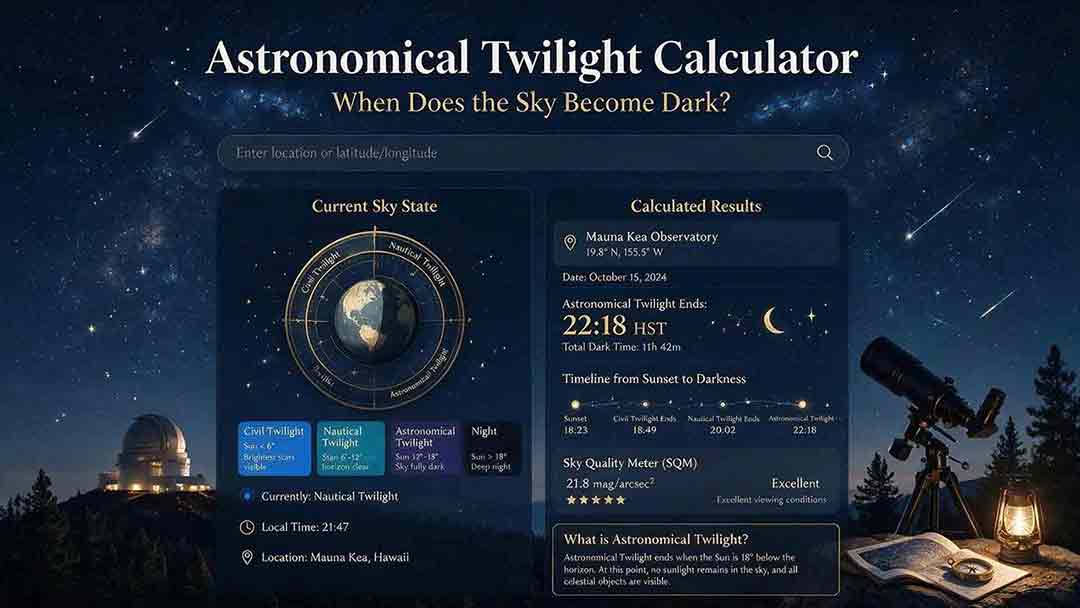
Astronomical Twilight Calculator: When Does the Sky Become Dark?
This guide explains how to use an astronomical twilight calculator to identify the end of evening astronomical twilight and the beginning of morning astronomical twilight for a selected date and location. It distinguishes sunset, civil dusk, nautical dusk, astronomical dusk, and the Sun-below-18° interval while clarifying that solar geometry does not guarantee a visibly dark sky. Readers learn how latitude, season, timezone, daylight-saving rules, moonlight, skyglow, clouds, haze, and high-latitude conditions affect practical planning. The article introduces two original tools: the Darkness Margin, which calculates how much of a session falls inside the Sun-below-18° interval, and a Task Threshold Matrix that matches observing goals to practical twilight stages. A worked cross-midnight example produces a 1-hour-48-minute dark interval. Troubleshooting guidance, planning checks, and authoritative USNO, NOAA, and National Park Service sources support the method.
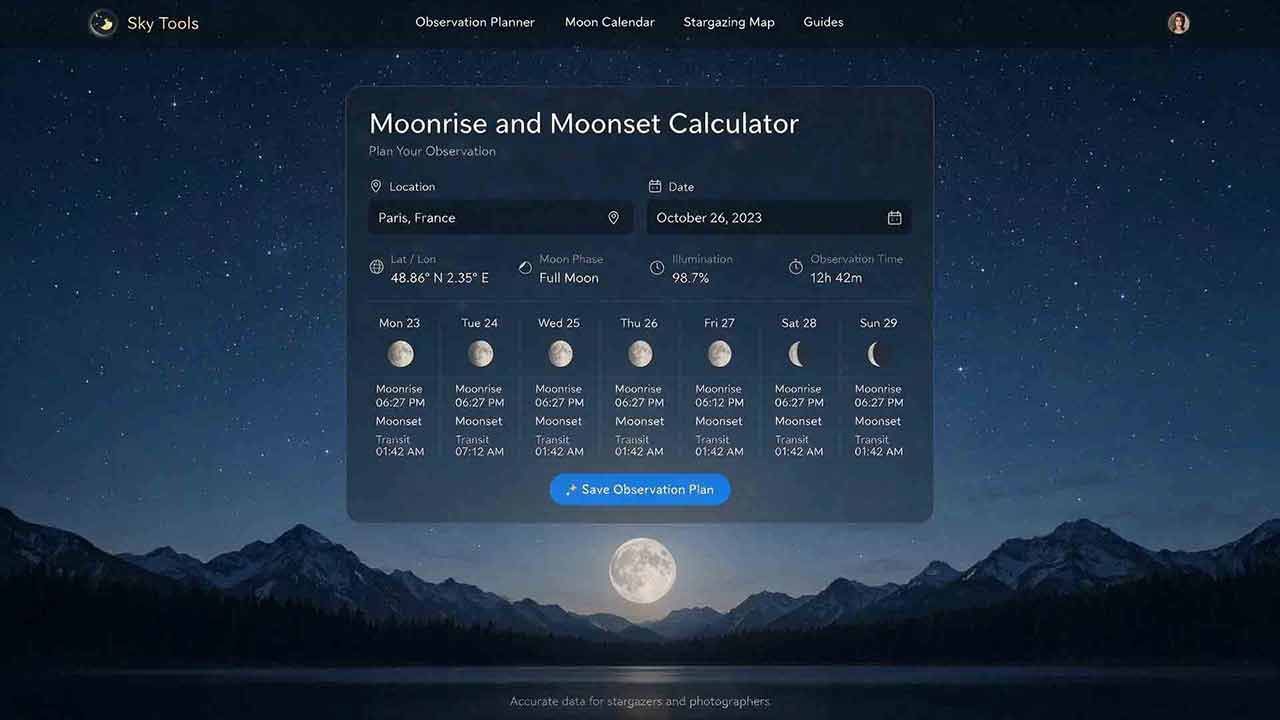
Moonrise and Moonset Calculator: Plan Your Observation
This guide explains how to use a moonrise and moonset calculator to plan lunar observation, astrophotography, meteor watching, and dark-sky sessions. Readers learn how date, coordinates, timezone, daylight-saving rules, observer height, atmospheric refraction, and the local horizon affect predicted event times. It defines moonrise, moonset, upper transit, altitude, azimuth, phase, and illumination, while explaining why a calculated horizon event may not match the first visible appearance of the Moon. The article introduces an original Three-Window Method that compares the sky window, Moon window, and target window, then provides a reproducible overlap calculation and a hypothetical example with a 37-minute fully dark, pre-moonrise interval. Practical tables cover missing rise or set events, high-latitude limitations, common errors, and recommendations for different observers. The guidance is based on NASA and U.S. Naval Observatory documentation.
Moon Phase Calculator: Find the Moon’s Phase for Any Date
This guide explains how to use a Moon phase calculator to identify the Moon’s general phase for any selected date and interpret the result accurately. It distinguishes phase labels from illuminated percentage, waxing or waning direction, lunar age, and exact primary-phase times. Readers learn why two calculators may show different labels for the same moment, how timezone conversion can place one Full Moon on different local dates, and why rounded values such as 100% illumination do not necessarily mark the exact Full Moon instant. The article also includes an original comparison showing why equal divisions of a 29.53-day lunar cycle can miss official primary-phase times by several hours. Practical tables help readers apply Moon phase information to lunar observation, crescent photography, meteor showers, deep-sky viewing, and moonlit landscapes. Historical calendar limits, troubleshooting advice, accuracy checks, and authoritative NASA and U.S. Naval Observatory sources are also included.