Astronomical Twilight Calculator: When Does the Sky Become Dark?

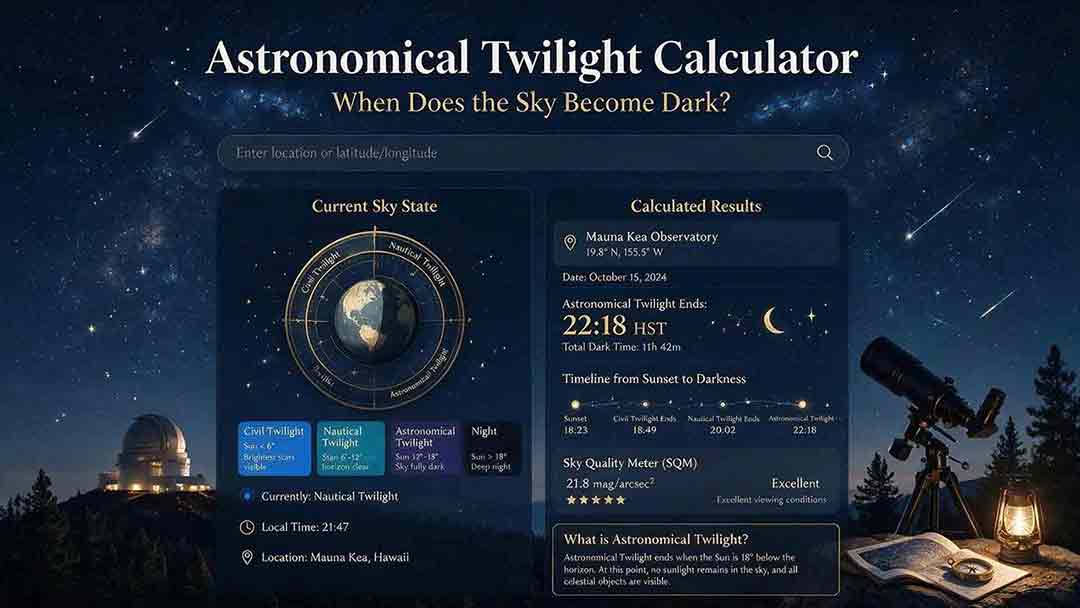
Astronomical Twilight Calculator: When Does the Sky Become Dark?
An Astronomical Twilight Calculator identifies when the Sun’s geometric center reaches 18° below the horizon. Evening astronomical twilight ends at that boundary, while morning astronomical twilight begins when the Sun rises back through it. In this guide, the interval between those events is called the astronomical-darkness window. The term describes solar geometry, not guaranteed visual darkness.
Key Takeaways
- Evening astronomical twilight ends when the Sun’s geometric center reaches 18° below the horizon.
- Sunset, civil dusk, nautical dusk, and astronomical dusk are different events.
- High-latitude summer nights may never reach the −18° boundary.
- Moonlight, artificial skyglow, clouds, haze, and nearby lighting can keep the sky bright after astronomical twilight ends.
- The most useful observing period is the overlap between the Sun-below-18° interval, the planned session, and the target’s requirements.
The sections below turn the calculator’s twilight times into a practical observation window.
How Do You Use an Astronomical Twilight Calculator?
Enter the observing date and location, confirm the timezone, and record both the evening and morning astronomical-twilight boundaries.
1. Select the Local Observation Date
Use the civil date that applies at the observing site.
An evening session often continues into the following date. When the session crosses midnight, retain the date with every clock time rather than comparing times alone.
2. Enter Accurate Coordinates
Latitude and longitude determine how the Sun moves below the local horizon.
A nearby city is usually sufficient for broad planning. Use the actual site coordinates when the dark interval is short, the location is at high latitude, or the observing site lies near a timezone boundary.
3. Confirm the Timezone and Daylight-Saving Rule
An incorrect time reference can shift every displayed event.
Check whether the calculator uses:
- a named timezone;
- a fixed UTC offset;
- the device timezone; or
- Coordinated Universal Time.
A fixed UTC offset does not automatically apply daylight-saving changes. NOAA also notes that automated timezone handling may be inaccurate for some historical or future dates.
4. Record the Full Twilight Sequence
For an overnight session, record:
- sunset;
- end of civil twilight;
- end of nautical twilight;
- end of evening astronomical twilight;
- beginning of morning astronomical twilight;
- sunrise.
The Sunrise and Sunset Calculator provides the horizon events, while the twilight result defines the three solar-depression boundaries.
5. Add Lunar and Site Conditions
Twilight times describe the Sun’s position. They do not measure total sky brightness.
Use the Moonrise and Moonset Calculator and Moon Phase Calculator to assess lunar interference. Use the Night Sky Darkness Calculator when artificial skyglow and site quality matter.
When Does Evening Astronomical Twilight End?
Evening astronomical twilight ends when the geometric center of the Sun reaches 18° below a level horizon.
The U.S. Naval Observatory defines three twilight stages using the Sun’s geometric depression below the horizon:
| Stage or interval | Solar-position condition | Evening meaning | Practical interpretation |
|---|---|---|---|
| Civil twilight | Sun reaches −6° | Civil twilight ends | Ordinary outdoor detail is fading and artificial lighting is often needed |
| Nautical twilight | Sun reaches −12° | Nautical twilight ends | The natural horizon becomes difficult to distinguish on a clear, Moonless night |
| Astronomical twilight | Sun reaches −18° | Astronomical twilight ends | Under clear, Moonless conditions away from artificial light, remaining twilight illumination is generally very faint |
| Sun-below−18° interval | Sun remains below −18° | Begins after astronomical dusk | Called the astronomical-darkness window in this guide; the sky may still be bright because of moonlight, skyglow, clouds, haze, or aurora |
The same boundaries occur in reverse before sunrise:
- morning astronomical twilight begins at −18°;
- morning nautical twilight begins at −12°;
- morning civil twilight begins at −6°;
- sunrise follows.
Astronomical dusk means the end of evening astronomical twilight. Astronomical dawn means the beginning of morning astronomical twilight.
The phrase astronomical-darkness window is a planning term used in this article. It is not a fourth official twilight category.
Why Is Sunset Not the Same as Darkness?
Sunset marks a horizon event, not the end of scattered sunlight.
After the Sun’s disk disappears, sunlight continues to illuminate the upper atmosphere. The sky passes through civil, nautical, and astronomical twilight before the Sun reaches −18°.
The time between sunset and astronomical dusk changes with:
- latitude;
- season;
- solar declination;
- the angle at which the Sun’s path crosses the horizon.
Near the equator, the Sun commonly descends at a steeper angle and twilight is relatively short. At higher latitudes, the solar path can meet the horizon at a shallow angle, producing much longer twilight.
A fixed statement such as “the sky becomes dark 90 minutes after sunset” is therefore not reliable across locations and seasons.
What Does Each Calculator Result Mean?
| Result | Direct meaning | Useful for | Does not guarantee |
|---|---|---|---|
| Sunset | The calculated setting event for the Sun | Early-evening and landscape planning | A dark sky |
| Civil dusk | The Sun reaches −6° | Outdoor visibility and early photography | Good contrast for faint stars |
| Nautical dusk | The Sun reaches −12° | Bright stars, planets, silhouettes, and setup | The end of all twilight |
| Astronomical dusk | The Sun reaches −18° | Start of the Sun-below−18° interval | A Moonless or low-light-pollution sky |
| Astronomical dawn | The Sun rises through −18° | End of the overnight Sun-below−18° interval | Immediate daylight |
| Twilight duration | Time between sunset and a selected twilight boundary | Comparing dates, seasons, and locations | A direct measurement of sky quality |
| Solar elevation | Angular position of the Sun relative to the horizon | Verifying the current twilight stage | Weather, moonlight, or artificial-light conditions |
Task Threshold Matrix: Which Darkness Level Do You Need?
The following matrix is a practical planning framework created for this guide. It is not an official visibility classification.
These thresholds are recommendations rather than universal guarantees. Target brightness, equipment, transparency, lunar position, artificial skyglow, and observer experience can change what is practical.
| Activity or target | Earliest practical threshold | Preferred condition | Additional check |
|---|---|---|---|
| Moon or bright planets | Civil or nautical twilight may work | Target clearly above the horizon | Altitude and local obstructions |
| Bright stars and clusters | Nautical twilight | Good atmospheric transparency | Moon position |
| Public telescope session | Late nautical or astronomical twilight | Bright targets first | Setup lighting and visitor safety |
| Milky Way observation | After astronomical twilight ends | Low moonlight and limited skyglow | Season and foreground direction |
| Faint galaxies and nebulae | Sun below −18° | Dark site and clear atmosphere | Target altitude and Moon separation |
| Meteor shower | Dark interval overlapping the active period | Low lunar interference | Radiant altitude |
| Night landscape photography | Depends on the intended balance | A selected twilight stage may be desirable | Weather, direction, and exposure plan |
| Long-exposure deep-sky imaging | Usually after astronomical twilight ends | Stable dark interval | Gradients, moonlight, and transparency |
The −18° boundary is therefore neither mandatory for every task nor sufficient for every task.
Original Planning Method: Calculate the Darkness Margin
The Darkness Margin is an original scheduling metric introduced in this guide. It is not an official U.S. Naval Observatory, NOAA, or professional-observatory standard.
It measures how much of a planned session falls inside the Sun-below−18° interval.
Define the Three Time Windows
- Session window: the time available for the observation.
- Astronomical-darkness window: from the end of evening astronomical twilight to the beginning of the next morning’s astronomical twilight.
- Target window: the time when the object or event is positioned usefully.
The practical observing period is the overlap of all required windows.
Use Full Date-and-Time Values
When a session crosses midnight, attach a calendar date to every boundary or place all values on one continuous local timeline.
For example, a session from July 30 at 9:30 p.m. to July 31 at 12:30 a.m. must not be treated as a negative-duration interval merely because 12:30 appears numerically earlier than 9:30.
Calculate the Overlap
For an overnight session:
Usable dark start = later of session start and evening astronomical-twilight end
Usable dark end = earlier of session end and the next morning’s astronomical-twilight beginning
Darkness Margin = maximum of zero and usable dark end minus usable dark start
If the usable end is earlier than the usable start, the session contains no Sun-below−18° interval.
What the Darkness Margin Does Not Measure
The calculation does not account for:
- moonlight;
- artificial skyglow;
- cloud cover;
- smoke, dust, or haze;
- target altitude;
- nearby lighting;
- setup time;
- visual dark adaptation.
The Darkness Margin is a scheduling metric, not a sky-brightness model.
Worked Example: How Much Dark Time Is Available?
The following figures are hypothetical. They are not a forecast for a real location.
Example Date-and-Time Values
- Selected evening date: July 30, 2026
- Sunset: July 30 at 8:17 p.m.
- Civil twilight ends: July 30 at 8:49 p.m.
- Nautical twilight ends: July 30 at 9:27 p.m.
- Astronomical twilight ends: July 30 at 10:12 p.m.
- Morning astronomical twilight begins: July 31 at 4:38 a.m.
- Planned session: July 30 at 9:30 p.m. to July 31 at 12:00 a.m.
Step 1: Find the Usable Dark Start
The session starts at 9:30 p.m., but evening astronomical twilight does not end until 10:12 p.m.
The later value is:
Usable dark start = July 30 at 10:12 p.m.
Step 2: Find the Usable Dark End
The session ends at midnight, before morning astronomical twilight begins at 4:38 a.m.
The earlier value is:
Usable dark end = July 31 at 12:00 a.m.
Step 3: Calculate the Darkness Margin
The interval from 10:12 p.m. to midnight is:
1 hour 48 minutes
The session also contains 42 minutes before astronomical dusk. That earlier period can be used for setup, focusing, bright planets, the Moon, or twilight landscape images.
| Observer | Practical use of the example session |
|---|---|
| Bright-planet observer | Begin before 10:12 p.m. if the target is already visible |
| Deep-sky observer | Use 9:30–10:12 p.m. for setup and begin faint targets afterward |
| Landscape photographer | Decide whether the twilight supports the intended foreground exposure |
| Meteor observer | Treat 10:12 p.m.–12:00 a.m. as the Sun-below−18° interval, then check Moon position and radiant altitude |
Why Can Two Twilight Calculators Show Different Times?
Small differences do not automatically mean that one tool is wrong.
Coordinates Differ
A city-center location and a rural site may use different latitude and longitude values.
Timezone Handling Differs
One service may apply a named timezone and daylight-saving database, while another may require a fixed UTC offset.
Dates Are Assigned Differently
An event after midnight may belong to the following local date even though the observing session began on the previous evening.
Algorithms and Rounding Differ
Calculators may use different solar-position algorithms, numerical tolerances, or display precision.
Historical Calendar Treatment Differs
NOAA’s Solar Calculator Glossary explains that its calculators extend the Gregorian calendar backward. Dates before October 15, 1582 therefore require additional historical-calendar care.
NOAA also warns that automatic timezone and daylight-saving values may be inaccurate for some historical or future dates.
Before judging a discrepancy, standardize the coordinates, date, timezone, UTC offset, and displayed precision.
Why Does Astronomical Twilight Sometimes Never End?
At sufficiently high latitude in summer, the Sun may not descend to 18° below the horizon.
A missing astronomical-dusk result can therefore describe a real solar-geometry condition rather than a calculation failure.
| Minimum solar elevation reached overnight | Correct interpretation |
|---|---|
| Sun remains above −6° | The location remains in daylight or civil twilight; nautical twilight is not reached |
| Sun falls below −6° but not −12° | Nautical twilight occurs through the darkest part of the night; astronomical twilight is not reached |
| Sun falls below −12° but not −18° | Astronomical twilight occurs but does not end; the Sun never reaches the −18° boundary |
| Sun reaches or falls below −18° | A Sun-below−18° interval occurs |
A calculator may display a blank value, a symbol, or no astronomical dusk when the −18° boundary is not crossed. Read the service legend before treating the result as an error.
For a high-latitude trip, calculate several dates. The first Sun-below−18° interval after summer may occur well after the solstice.
Does Astronomical Dusk Guarantee a Dark Sky?
No. Astronomical twilight is based on solar geometry, not total sky brightness.
The sky can remain bright after astronomical dusk because of:
- a bright or high Moon;
- urban and suburban skyglow;
- illuminated clouds;
- smoke, aerosols, dust, or haze;
- reflective snow or pale ground;
- nearby unshielded lighting;
- aurora or other natural light sources.
The U.S. National Park Service explains that artificial light scattered through the atmosphere produces skyglow and reduces the contrast of stars and other celestial objects. Clouds and airborne particles can intensify that scattering.
Use three separate checks:
- Solar condition: Has evening astronomical twilight ended?
- Lunar condition: Is the Moon below the horizon, faint, low, or well separated from the target?
- Site condition: Are skyglow, cloud, haze, smoke, glare, and local lighting acceptably low?
A positive result from the twilight calculator answers only the first question.
Common Mistakes and Troubleshooting
| Problem | Likely cause | Recommended action |
|---|---|---|
| Twilight times are one hour early or late | Daylight-saving or timezone mismatch | Verify the date-specific timezone or UTC offset |
| Astronomical dusk appears on the next date | The event occurs after local midnight | Read the date and time together |
| No astronomical dusk is shown | The Sun never reaches −18° | Check the minimum solar elevation and service legend |
| The sky remains bright after astronomical dusk | Moonlight, skyglow, cloud, haze, smoke, or snow reflection | Check lunar and site conditions |
| Two calculators differ | Coordinates, timezone, date handling, rounding, or algorithms differ | Standardize all inputs before comparing |
| A historical result looks inconsistent | Calendar or historical timezone treatment differs | Review the calculator’s historical-date documentation |
Astronomical-Twilight Planning Checklist
- Confirm the observing-site coordinates.
- Verify the local date, timezone, and daylight-saving rule.
- Record sunset and the three evening twilight boundaries.
- Record the following morning’s astronomical-twilight beginning.
- Keep full dates attached to times that cross midnight.
- Calculate the Darkness Margin inside the session.
- Check Moon phase, moonrise, moonset, and lunar altitude.
- Review cloud, haze, smoke, artificial light, terrain, and target altitude.
- Allow time for setup, focusing, and dark adaptation.
Conclusion
Evening astronomical twilight ends when the Sun’s geometric center reaches 18° below the horizon. The Sun-below−18° interval is a precise solar-position window, but its usefulness depends on the Moon, atmosphere, artificial light, target position, and observing goal.
Bright planets and the Moon may be practical earlier. Faint galaxies, nebulae, the Milky Way, deep-sky images, and faint meteors generally benefit from a positive Darkness Margin combined with low moonlight, clear air, and limited skyglow.
Frequently Asked Questions
Is Astronomical Twilight the Same as Night?
Astronomical twilight is the final twilight stage. In this guide, the interval after evening astronomical twilight ends and before morning astronomical twilight begins is called the astronomical-darkness window.
How Long After Sunset Does Astronomical Twilight End?
There is no universal delay. The interval depends mainly on latitude, season, solar declination, and the angle at which the Sun’s path crosses the horizon.
Why Is No Astronomical Dusk Listed?
The Sun may not reach 18° below the horizon, especially during summer at high latitude. Check the minimum solar elevation and the calculator’s output legend.
Does Moonlight Change Astronomical-Twilight Times?
No. Twilight boundaries depend on the Sun’s position. Moonlight changes practical sky brightness but not the calculated twilight event.
Sources
U.S. Naval Observatory — Rise, Set, and Twilight Definitions
Definitions of civil, nautical, and astronomical twilight and the −6°, −12°, and −18° solar-depression boundaries. Accessed July 30, 2026.U.S. Naval Observatory — Table of Sunrise, Sunset, Moonrise, Moonset, or Twilight Times for an Entire Year
Location-based annual twilight tables and service documentation. Accessed July 30, 2026.NOAA Global Monitoring Laboratory — Solar Calculator Glossary
Solar-elevation definitions, astronomical-twilight terminology, coordinate conventions, and historical-calendar guidance. Accessed July 30, 2026.NOAA Global Monitoring Laboratory — Solar Calculator
Solar-position calculator and cautions concerning timezone, daylight-saving, atmospheric, and algorithmic uncertainty. Accessed July 30, 2026.U.S. National Park Service — Light Pollution
Explanation of skyglow, atmospheric scattering, glare, aerosols, and cloud effects on night-sky visibility. Accessed July 30, 2026.
More from Sky & Time Tools
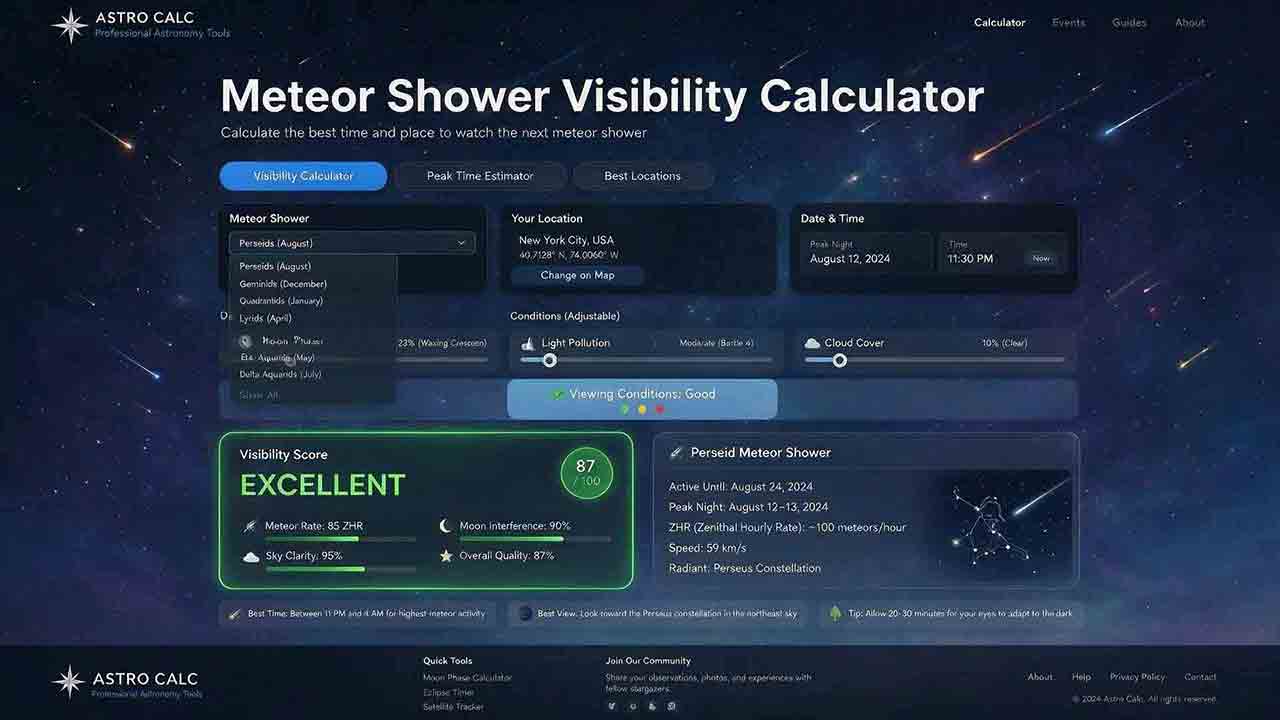
Meteor Shower Visibility Calculator
This guide explains how to use a meteor shower visibility calculator to identify a locally favorable observing window instead of relying only on a published peak time or Zenithal Hourly Rate. It covers activity periods, radiant altitude, astronomical darkness, Moon timing, weather, limiting magnitude, population index, and the distinction between named-shower members, sporadic meteors, and meteors from overlapping showers. The article introduces two original planning tools: the Five-Layer Meteor Test and the Meteor Opportunity Window, which calculates the overlap between activity, radiant, darkness, Moon, weather, and session constraints. A reproducible cross-midnight example compares illustrative 20° and 40° radiant thresholds, producing windows of 2 hours 20 minutes and 1 hour 40 minutes. Practical guidance addresses moonlight, viewing direction, dark adaptation, calculator disagreements, troubleshooting, and responsible site selection, supported by NASA, IMO, AMS, and U.S. Naval Observatory sources.
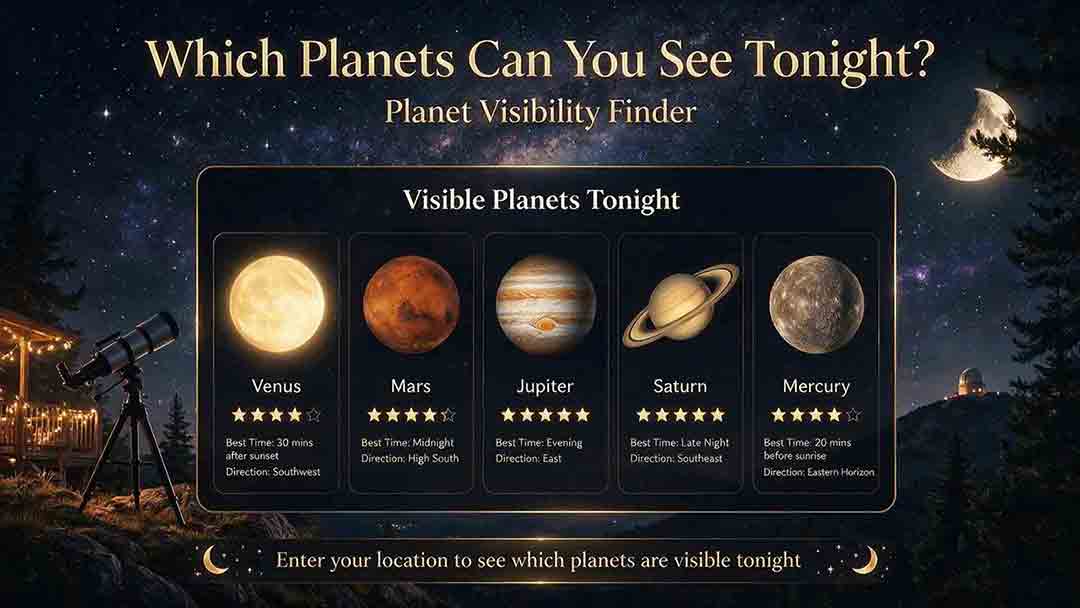
Planet Visibility Finder: Which Planets Can You See Tonight?
This guide explains how to use a planet visibility finder to decide which planets are realistically observable for a selected date, time, and location. It shows why an object being above the horizon does not guarantee visibility and explains the roles of altitude, azimuth, apparent magnitude, solar elongation, twilight, moonlight, weather, and local obstructions. Readers learn which planets are normally visible without a telescope, how Mercury and Venus differ from the outer planets, and why two finders may produce different results. The article introduces an original Four-Gate Visibility Test covering position, solar light, detectability, and site timing, plus a reproducible Useful Viewing Window calculation. A hypothetical example compares a 1-hour-26-minute naked-eye window with an 18-minute higher-altitude telescope window. Practical troubleshooting, safety guidance, and NASA, USNO, and JPL sources support the planning method.
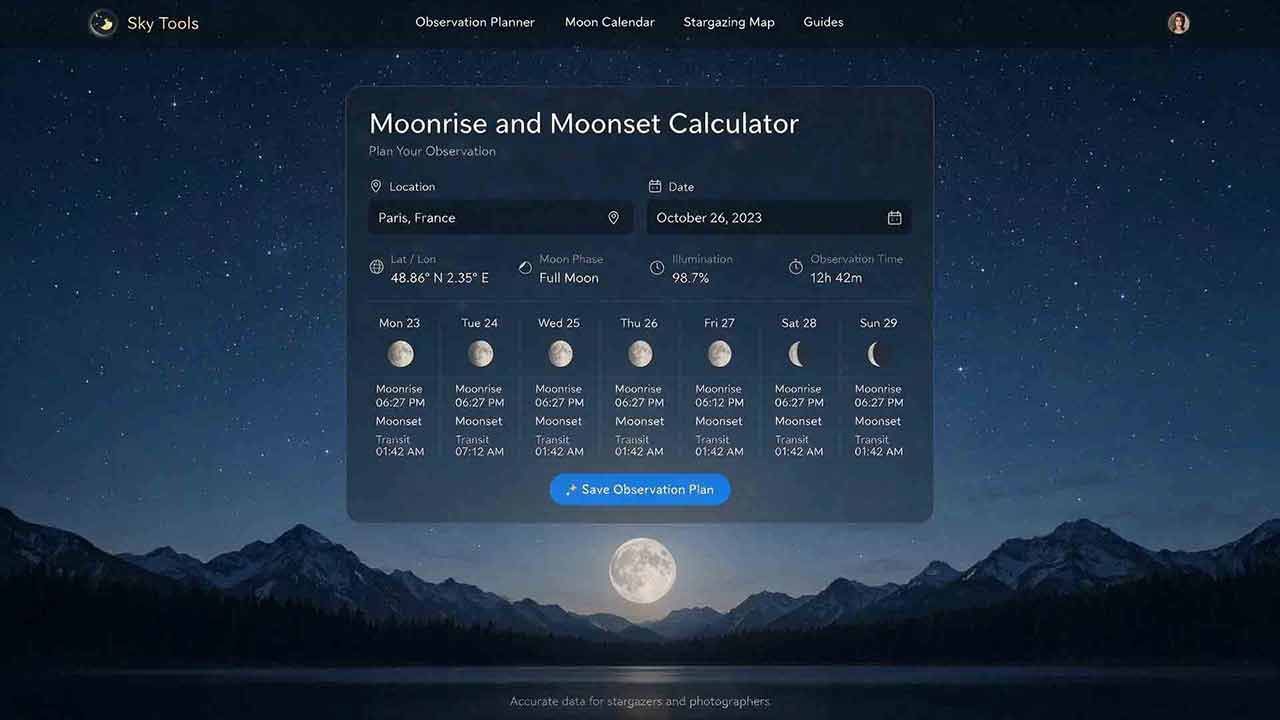
Moonrise and Moonset Calculator: Plan Your Observation
This guide explains how to use a moonrise and moonset calculator to plan lunar observation, astrophotography, meteor watching, and dark-sky sessions. Readers learn how date, coordinates, timezone, daylight-saving rules, observer height, atmospheric refraction, and the local horizon affect predicted event times. It defines moonrise, moonset, upper transit, altitude, azimuth, phase, and illumination, while explaining why a calculated horizon event may not match the first visible appearance of the Moon. The article introduces an original Three-Window Method that compares the sky window, Moon window, and target window, then provides a reproducible overlap calculation and a hypothetical example with a 37-minute fully dark, pre-moonrise interval. Practical tables cover missing rise or set events, high-latitude limitations, common errors, and recommendations for different observers. The guidance is based on NASA and U.S. Naval Observatory documentation.
Explore More Topics
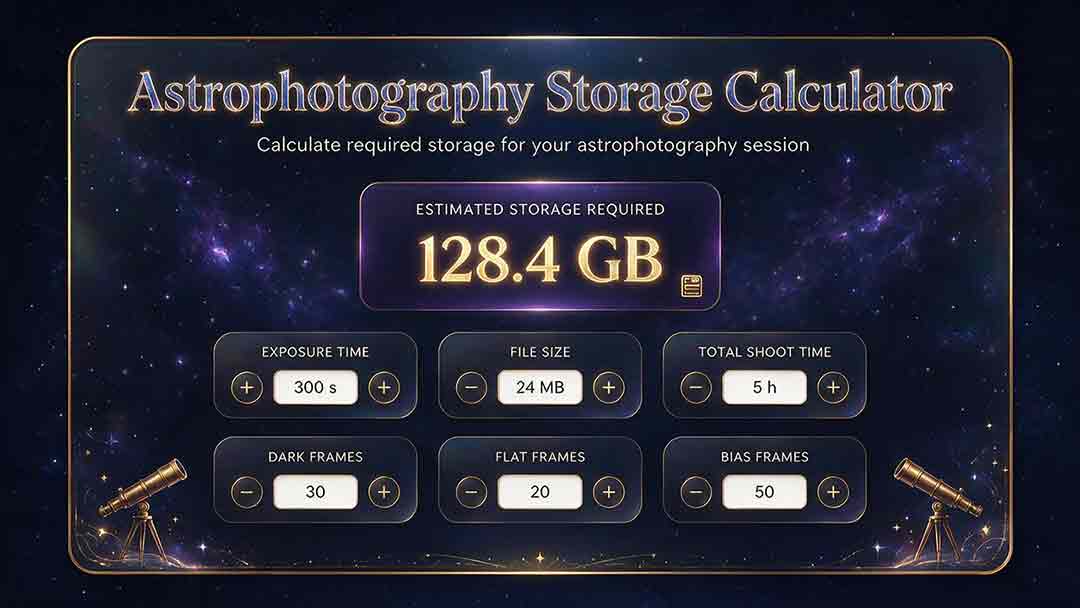
Astrophotography Storage Calculator
This guide explains how to estimate storage for astrophotography capture, processing, and backup without relying on misleading megapixel shortcuts. It compares measured-file, uncompressed-array, and bitrate methods; distinguishes mean, median, high-percentile, and maximum file-size statistics; and explains decimal versus binary storage units. Readers learn how FITS headers, padding, HDUs, RAW compression, calibration frames, RGB conversion, drizzle, mosaics, caches, and temporary files affect project size. Original planning tools include the Four-Bucket Storage Ledger, the Capture–Process–Protect Check, and a clearly defined storage expansion ratio. Worked examples show how to calculate peak logical data, project-relative headroom, complete-copy footprint, media count, write rate, and transfer time. The article also covers integrity verification, backup limitations, retention decisions, and troubleshooting. It is designed to help astrophotographers build realistic capacity plans for single sessions, multi-night projects, planetary video, star trails, and long-term archives.
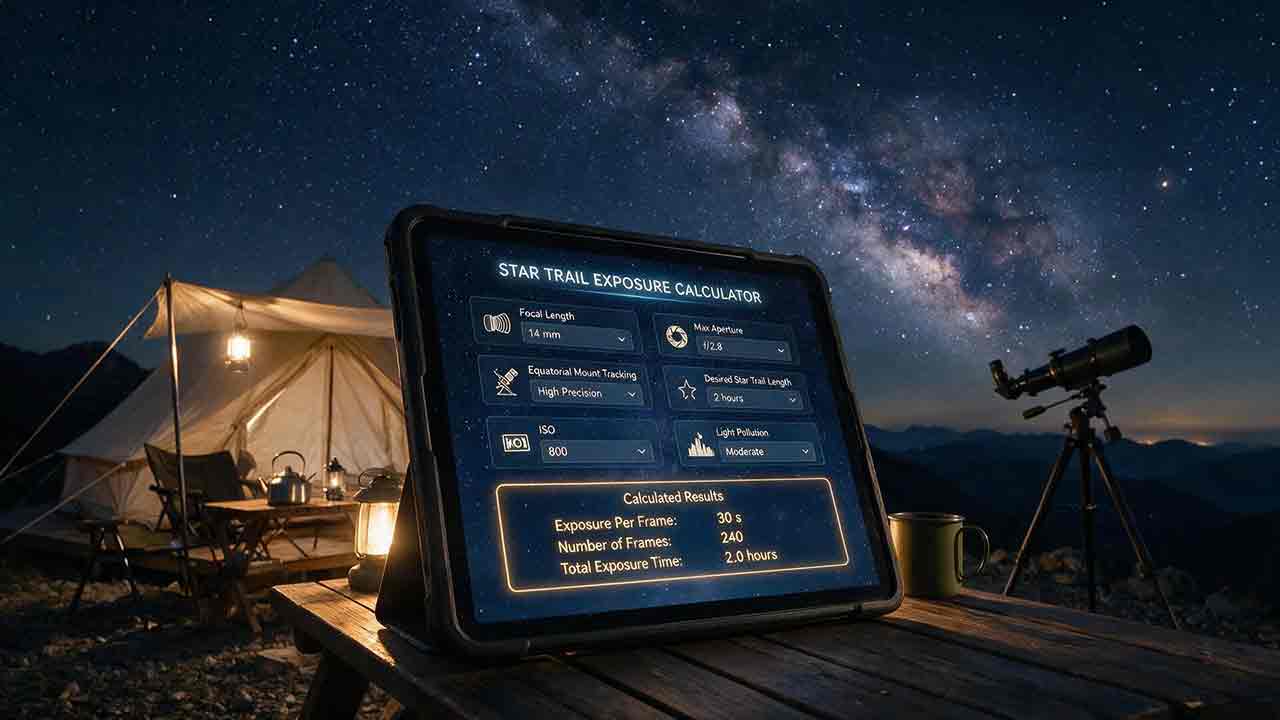
Star Trail Exposure Calculator
This guide explains how to calculate star-trail exposure time from Earth’s sidereal rotation, stellar declination, and local image scale. It distinguishes polar sweep, declination-adjusted sky-path length, projected pixel length, recorded sweep, missing sweep, and the full start-to-end span of a stacked sequence. Original tables compare trail lengths at several declinations, quantify one-second frame gaps at different image scales, and show how recorded time, gap time, duty cycle, and sequence sweep relate. The Trail–Frame–Sequence Check provides a practical framework for separating celestial geometry, per-frame reliability, and sequence continuity. Worked examples also address the celestial-pole edge case, local WCS-based pixel movement, frame-count limits, long-exposure noise reduction, and the difference between a single exposure and stacked frames. Readers can use the article to plan smoother trails, avoid misleading sequence calculations, and verify expected motion with native-resolution test images.
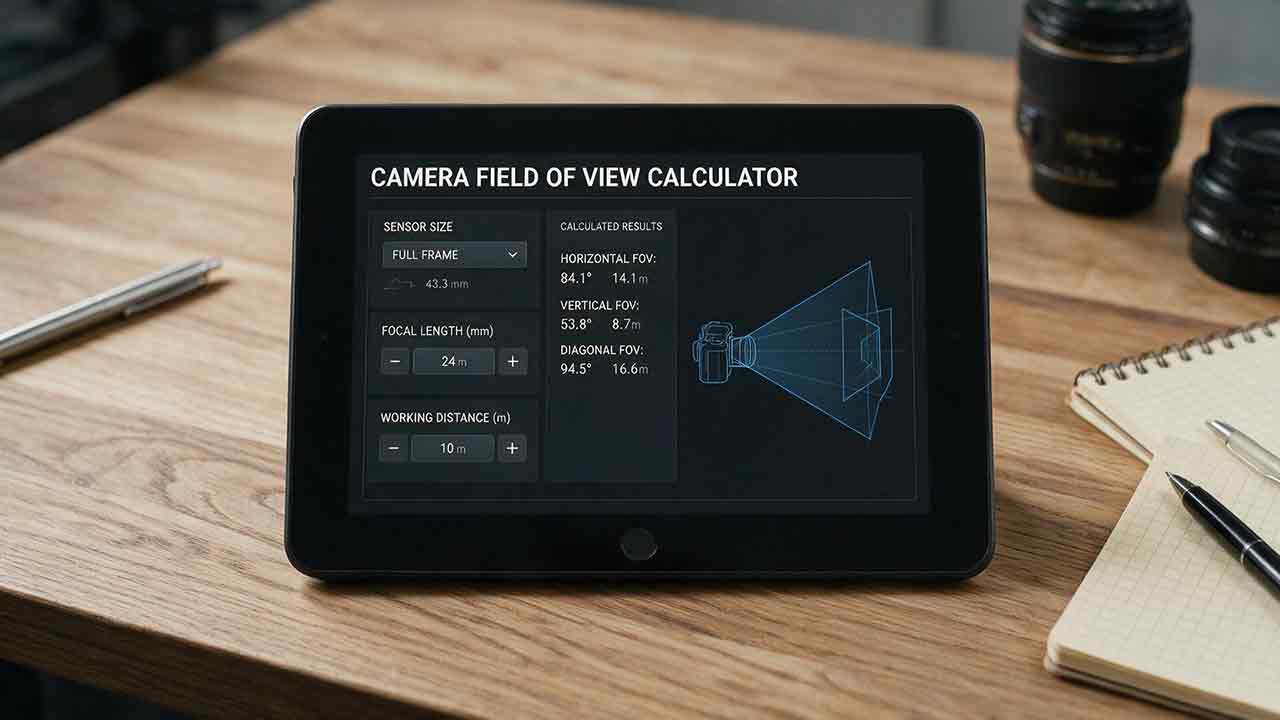
Camera Field of View Calculator
This guide explains how to calculate horizontal, vertical, and diagonal camera field of view from the recorded active sensor dimensions and effective focal length. It distinguishes physical focal length from crop-factor comparisons, shows why aspect ratio and target rotation affect framing, and provides independently calculated reference tables for common sensor sizes and focal lengths. The original Frame Envelope Check separates ideal frame geometry, the target envelope, and the usable frame retained after dithering, registration, distortion correction, and cropping. Worked examples demonstrate target occupancy, maximum permitted focal length, rotated bounding boxes, and mosaic panel counts with overlap. The article also explains radians versus degrees, crop and stabilization modes, focus breathing, rectilinear versus fisheye projection, and plate-solving verification through a celestial WCS. Readers can use the formulas, margin budget, troubleshooting table, and framing checklist to plan wide-field compositions, small-target imaging, or mosaics without treating a mathematical edge-to-edge fit as a guaranteed final frame.