Astronomical Distance Converter

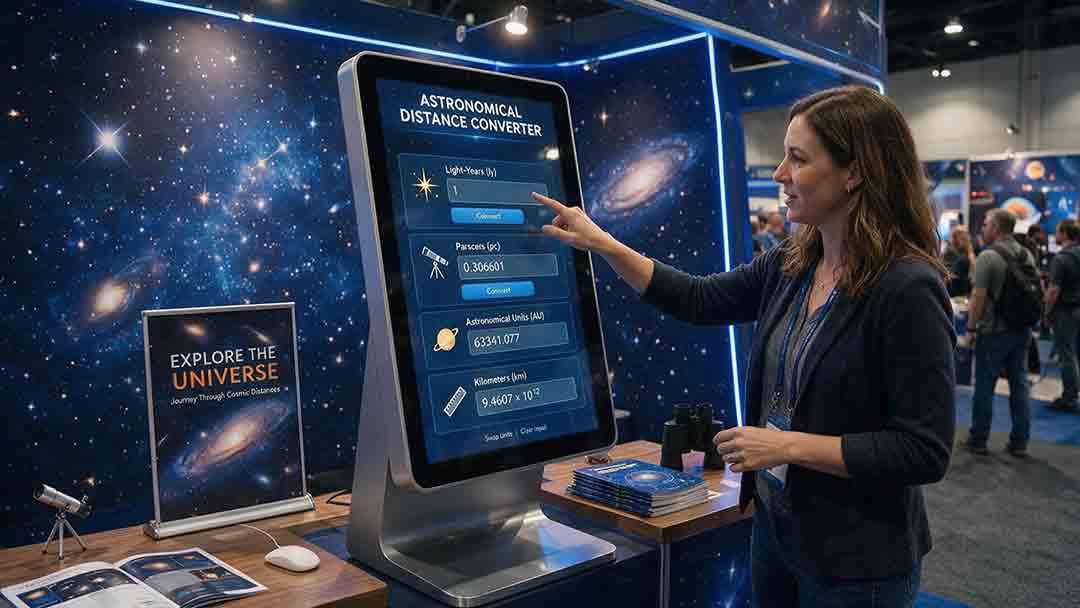
Astronomical Distance Converter
An astronomical distance converter expresses the same physical length in another unit, such as kilometers, astronomical units, light-years, or parsecs. Enter a distance, select its current unit, and choose an output unit. A reliable conversion uses documented definitions, retains precision during calculation, and does not imply that a rounded or uncertain astronomical measurement has become more accurate.
Key Takeaways
- Use kilometers for local spaceflight scales, astronomical units for solar-system distances, and light-years or parsecs for interstellar distances.
- Unit conversion changes how a distance is written; it does not change the physical distance or improve its measurement accuracy.
- The astronomical unit has an exact value in meters, while the parsec has an exact mathematical relationship to the astronomical unit.
- Light-seconds, light-minutes, and light-years are units of distance, even though their names contain time units.
- Redshift and the current separation of moving planets cannot be determined through unit conversion alone.
This guide explains how the converter works, which units it supports, how to select a useful output unit, how to verify the arithmetic, and where ordinary unit conversion ends and specialized astronomical modeling begins.
Calculation standard: The converter first normalizes each input to meters and then converts that meter value into the selected output unit. Intermediate values are not rounded. Displayed results should be rounded according to the precision of the input and the purpose of the result.
How Do You Use the Astronomical Distance Converter?
Enter the numerical distance, select the source unit, and choose the target unit. Before accepting the result, confirm that the input unit and stated precision match the original source.
Step 1: Enter the Distance
Enter a finite, non-negative number.
Examples include:
384400kilometers1astronomical unit4.24light-years2.637parsecs8.2kiloparsecs100megaparsecs
A value of zero converts to zero in every distance unit. A negative number does not represent an ordinary physical path length and should not be treated as a valid astronomical distance.
Scientific notation is useful for very large or very small values. For example:
[4.01135\times10^{13}\ \text{km}]
is a compact way to write approximately 40.1 trillion kilometers.
Step 2: Select the Source Unit
The source unit must match the entered value.
Entering 149597870.7 as kilometers represents exactly one astronomical unit. Entering the same number as miles represents a much greater distance.
A converter cannot determine the intended unit from the number alone.
Step 3: Select the Target Unit
Choose an output unit that suits the scale and intended audience.
Typical choices are:
- kilometers for spacecraft and nearby solar-system distances
- miles for readers who use U.S. customary units
- astronomical units for planetary orbits and solar-system comparisons
- light-seconds, light-minutes, or light-hours for signal-scale distances
- light-years for accessible descriptions of stellar distances
- parsecs for astrometry and professional astronomy
- kiloparsecs for galactic structure
- megaparsecs or gigaparsecs for extragalactic and cosmological scales
Step 4: Review the Significant Figures
A conversion can generate many decimal places, but those digits are not necessarily meaningful.
For example:
[4.2\ \text{ly}\approx1.287725854\ \text{pc}]
The arithmetic is valid, but the input contains only two significant figures. A defensible displayed result is therefore:
[4.2\ \text{ly}\approx1.3\ \text{pc}]
Step 5: Confirm That You Need Conversion Rather Than a New Distance
A converter answers:
How can this known distance be expressed in another unit?
It does not answer:
What is the current distance between two moving objects?
A current planet, moon, asteroid, or spacecraft distance must first be obtained from an ephemeris or orbital calculation.
How Does the Astronomical Distance Converter Work?
The converter uses meters as a common intermediate unit.
Let:
- (x_s) be the entered numerical value
- (F_s) be the number of meters in one source unit
- (F_t) be the number of meters in one target unit
- (x_t) be the converted numerical value
Then:
[x_tx_s\times\frac{F_s}{F_t}]
This common-base method is easier to audit than maintaining a separate formula for every possible pair of units.
Example: Converting 2 Astronomical Units to Kilometers
One astronomical unit is exactly:
[149{,}597{,}870{,}700\ \text{m}]
Therefore:
[2\ \text{au}\times\frac{149{,}597{,}870{,}700\ \text{m}}{1\ \text{au}}\times\frac{1\ \text{km}}{1{,}000\ \text{m}}]
[299{,}195{,}741.4\ \text{km}]
The physical distance has not changed. Only its numerical representation and unit have changed.
Which Units Does the Converter Support?
The converter described on this page supports the following distance units.
| Scale group | Supported units |
|---|---|
| Terrestrial and spacecraft scale | meters, kilometers, international miles |
| Solar-system scale | astronomical units |
| Light-distance scale | light-seconds, light-minutes, light-hours, light-days, light-years |
| Stellar and galactic scale | parsecs, kiloparsecs, megaparsecs, gigaparsecs |
All of these are units of length.
A light-minute, for example, is not a duration in this context. It is the distance that light travels through a vacuum during 60 seconds.
Unit Symbols and Capitalization
| Unit | Recommended symbol |
|---|---|
| meter | m |
| kilometer | km |
| international mile | mi |
| astronomical unit | au |
| light-year | ly |
| parsec | pc |
| kiloparsec | kpc |
| megaparsec | Mpc |
| gigaparsec | Gpc |
Capitalization matters for metric prefixes:
kmeans kilo, or (10^3)Mmeans mega, or (10^6)Gmeans giga, or (10^9)
Therefore, Mpc means megaparsec. Writing mpc would indicate a different prefix and should not be treated as an equivalent symbol.
The International Astronomical Union recommends the lowercase symbol au, although uppercase AU remains common in general writing and search queries.
Which Unit Definitions Are Used?
The following standards provide the conversion basis used throughout this guide.
| Unit | Value in meters | Treatment |
|---|---|---|
| meter | (1) | SI base unit |
| kilometer | (1{,}000) | Exact |
| international mile | (1{,}609.344) | Exact |
| astronomical unit | (149{,}597{,}870{,}700) | Exact |
| light-second | (299{,}792{,}458) | Exact |
| light-minute | (17{,}987{,}547{,}480) | Exact |
| light-hour | (1{,}079{,}252{,}848{,}800) | Exact |
| light-day | (25{,}902{,}068{,}371{,}200) | Exact |
| light-year | (9{,}460{,}730{,}472{,}580{,}800) | Exact under the stated Julian-year convention |
| parsec | (\frac{648{,}000}{\pi}\ \text{au}) | Exact relation; decimal representation is approximate |
| kiloparsec | (1{,}000\ \text{pc}) | Exact decimal multiple |
| megaparsec | (1{,}000{,}000\ \text{pc}) | Exact decimal multiple |
| gigaparsec | (1{,}000{,}000{,}000\ \text{pc}) | Exact decimal multiple |
The international mile is exactly 1,609.344 meters under the modern international definition. The NIST Guide to the SI distinguishes it from the older U.S. survey mile used in some historical surveying records.
Why Is the Speed of Light Exact?
The Bureau International des Poids et Mesures definition of the metre fixes the speed of light in vacuum at exactly:
[c299{,}792{,}458\ \text{m/s}]
This gives exact light-distance relationships such as:
[1\ \text{light-second}299{,}792{,}458\ \text{m}]
and:
[1\ \text{light-minute}60\ \text{light-seconds}]
The exactness applies to the unit definition. It does not make a measured stellar or planetary distance exact.
How Is the Astronomical Unit Defined?
The astronomical unit is a fixed unit of length.
The International Astronomical Union’s 2012 Resolution B2 defines:
[1\ \text{au}149{,}597{,}870{,}700\ \text{m}]
Therefore:
[1\ \text{au}149{,}597{,}870.7\ \text{km}]
The astronomical unit is not defined as Earth’s current distance from the Sun. Earth moves along a noncircular orbit, so the instantaneous Sun–Earth distance changes while the unit remains fixed.
How Is a Light-Year Defined?
A light-year is the distance light travels through a vacuum in one Julian year.
This converter adopts:
[1\ \text{Julian year}365.25\ \text{days}]
and:
[1\ \text{day}86{,}400\ \text{s}]
Therefore:
[1\ \text{Julian year}31{,}557{,}600\ \text{s}]
Multiplying by the exact speed of light gives:
[1\ \text{ly}299{,}792{,}458\times31{,}557{,}600\ \text{m}][1\ \text{ly}
9{,}460{,}730{,}472{,}580{,}800\ \text{m}]
or:
[1\ \text{ly}9{,}460{,}730{,}472{,}580.8\ \text{km}]
A light-year is a distance. A statement such as “the star is four light-years away” does not mean that a spacecraft would reach it in four years.
How Is a Parsec Defined?
A parsec is an astronomical unit of length connected to a parallax angle of one arcsecond.
For unit conversion, the exact relationship adopted through IAU 2015 Resolution B2 is:
[1\ \text{pc}\frac{648{,}000}{\pi}\ \text{au}]
The resolution text and supporting explanation are reproduced in the accompanying paper, IAU 2015 Resolution B2 on bolometric magnitude scales.
Using the exact astronomical-unit value:
[1\ \text{pc}\approx206{,}264.806247096\ \text{au}]
[1\ \text{pc}\approx3.085677581491367\times10^{16}\ \text{m}]
and:
[1\ \text{pc}\approx3.261563777167\ \text{ly}]
The relationship involving (\pi) is exact. Its decimal representation continues indefinitely and must be rounded for display.
NASA’s Universe Glossary describes a parsec as the distance associated with a parallax of one arcsecond and gives the commonly rounded value of 3.262 light-years.
Which Astronomical Distance Unit Should You Choose?
Choose a unit that keeps the number readable, fits the scientific context, and does not imply more precision than the source supports.
The Scale–Purpose–Precision Framework
A practical unit choice can be made with three checks:
- Scale: How large is the distance?
- Purpose: Who will read or use the result?
- Precision: How accurately is the source distance known?
| Situation | Usually useful unit | Reason |
|---|---|---|
| Satellite altitude or nearby spacecraft range | km | Compact and familiar |
| General U.S. audience comparison | mi | Familiar customary unit |
| Planetary orbit or solar-system distance | au | Keeps values manageable |
| Signal-scale solar-system distance | light-seconds or light-minutes | Shows propagation scale |
| Nearby star for general readers | ly | Intuitive connection to light travel |
| Stellar catalog or parallax work | pc | Standard astrometric unit |
| Structure within a galaxy | kpc | Avoids large parsec values |
| Distance between galaxies | Mpc | Standard extragalactic scale |
| Largest modeled cosmic scales | Gpc | Keeps billion-parsec values readable |
These are practical recommendations rather than mathematical restrictions. Any distance can be expressed in any compatible distance unit.
Which Is Better: Light-Years or Parsecs?
Neither unit is universally better.
| Light-years | Parsecs |
|---|---|
| Familiar to general readers | Common in professional astronomy |
| Makes light-travel scale intuitive | Connected directly to parallax conventions |
| Common in educational writing | Used extensively in catalogs and research |
| Convenient for nearby stars | Extends naturally to kpc, Mpc, and Gpc |
Use light-years when immediate interpretation matters most. Use parsecs when working with astrometry, scientific catalogs, galactic structure, or professional literature.
Astronomical Distance Conversion Reference Table
The following values are calculated from the definitions stated above.
| Starting distance | Kilometers | Astronomical units | Light-years | Parsecs |
|---|---|---|---|---|
| 1 au | 149,597,870.7 | 1 | 0.00001581250741 | 0.000004848136811 |
| 1 ly | 9,460,730,472,580.8 | 63,241.07708 | 1 | 0.3066013938 |
| 1 pc | 30,856,775,814,913.67 | 206,264.8062 | 3.261563777 | 1 |
| 1 kpc | (3.085677581\times10^{16}) | (2.062648062\times10^8) | 3,261.563777 | 1,000 |
| 1 Mpc | (3.085677581\times10^{19}) | (2.062648062\times10^{11}) | 3,261,563.777 | 1,000,000 |
| 1 Gpc | (3.085677581\times10^{22}) | (2.062648062\times10^{14}) | (3.261563777\times10^9) | (10^9) |
The displayed values are rounded. The converter should retain greater precision internally and round only the final output.
Which Values Can Verify the Converter?
The following cases can be used to audit a converter implementation.
| Test input | Expected conversion |
|---|---|
| 1 km to m | exactly 1,000 m |
| 1 international mile to km | exactly 1.609344 km |
| 1 au to km | exactly 149,597,870.7 km |
| 1 au to light-seconds | approximately 499.004783836 light-seconds |
| 1 light-second to km | exactly 299,792.458 km |
| 1 light-minute to light-seconds | exactly 60 light-seconds |
| 1 light-hour to light-minutes | exactly 60 light-minutes |
| 1 light-day to light-hours | exactly 24 light-hours |
| 1 light-year to light-seconds | exactly 31,557,600 light-seconds |
| 1 light-year to au | approximately 63,241.0770843 au |
| 1 parsec to light-years | approximately 3.26156377717 ly |
| 1 kiloparsec to parsecs | exactly 1,000 pc |
| 1 megaparsec to parsecs | exactly 1,000,000 pc |
| 1 gigaparsec to megaparsecs | exactly 1,000 Mpc |
These extended values are intended for implementation testing. They do not imply that every user-entered distance is known to the same precision.
Back-Conversion Identity Test
A useful implementation check is to convert a value into another unit and then convert the result back into the original unit.
For an input (x):
[x\rightarrowy\rightarrowx']
A well-implemented converter should return:
[x'\approx x]
within its numerical and display precision.
For example:
[4.24\ \text{ly}\rightarrow1.29998990965\ \text{pc}\rightarrow4.24\ \text{ly}]
This test can reveal incorrect constants, reversed ratios, or premature rounding.
Worked Example 1: A Representative Earth–Moon Distance
Use a rounded representative Earth–Moon distance of:
[3.844\times10^5\ \text{km}]
For this example, the input is treated as having four significant figures.
Kilometers to Miles
[384{,}400\div1.609344]
[\approx238{,}855.0863\ \text{mi}]
Rounded to four significant figures:
[2.389\times10^5\ \text{mi}]
Kilometers to Astronomical Units
[384{,}400\div149{,}597{,}870.7]
[\approx0.00256955529\ \text{au}]
Rounded to four significant figures:
[0.002570\ \text{au}]
Kilometers to Light-Seconds
[384{,}400\div299{,}792.458]
[\approx1.282220382\ \text{light-seconds}]
Rounded to four significant figures:
[1.282\ \text{light-seconds}]
The same representative distance can therefore be written as approximately:
- (3.844\times10^5) km
- (2.389\times10^5) mi
- (0.002570) au
- (1.282) light-seconds
- (4.063\times10^{-8}) light-years
Every summary value uses four significant figures. The actual Earth–Moon distance varies, so this example demonstrates unit conversion rather than providing a live lunar range.
Worked Example 2: Converting 4.24 Light-Years
Suppose a source lists a stellar distance as:
[4.24\ \text{ly}]
Light-Years to Parsecs
[4.24\times0.3066013938]
[\approx1.29999\ \text{pc}]
Because the input has three significant figures, the appropriate displayed result is:
[1.30\ \text{pc}]
Light-Years to Astronomical Units
[4.24\times63{,}241.0770843]
[\approx268{,}142\ \text{au}]
Light-Years to Kilometers
[4.24\times9{,}460{,}730{,}472{,}580.8]
[\approx4.01135\times10^{13}\ \text{km}]
A precision-aware summary is:
- 4.24 light-years
- 1.30 parsecs
- approximately (2.68\times10^5) astronomical units
- approximately (4.01\times10^{13}) kilometers
Worked Example 3: Converting 2.637 Parsecs
Suppose a catalog gives:
[2.637\ \text{pc}]
Parsecs to Light-Years
[2.637\times3.261563777167]
[\approx8.60074368\ \text{ly}]
Rounded to four significant figures:
[8.601\ \text{ly}]
Parsecs to Kilometers
[2.637\times3.085677581491367\times10^{13}]
[\approx8.13693\times10^{13}\ \text{km}]
Rounded to four significant figures:
[8.137\times10^{13}\ \text{km}]
The parsec value may be preferable in an astrometric context, while the light-year value may be easier for a general audience to interpret.
Worked Example 4: Converting a Galactic-Scale Distance
Consider:
[8.2\ \text{kpc}]
First:
[8.2\ \text{kpc}8{,}200\ \text{pc}]
Then:
[8{,}200\times3.261563777167]
[\approx26{,}744.8\ \text{ly}]
With two significant figures:
[8.2\ \text{kpc}\approx27{,}000\ \text{ly}]
The same distance in kilometers is approximately:
[2.5\times10^{17}\ \text{km}]
Kilometers are mathematically valid, but kiloparsecs communicate the galactic scale more efficiently.
How Should Scientific Notation Be Used?
Scientific notation makes the order of magnitude visible without requiring a long string of digits.
Its standard form is:
[a\times10^n]
where:
[1\leq |a|<10]
For example:
[40{,}113{,}497{,}203{,}742.6\ \text{km}]
can be written as:
[4.01134972037426\times10^{13}\ \text{km}]
For user-facing output, the number would normally be rounded according to the source precision:
[4.01\times10^{13}\ \text{km}]
Recommended Display Pattern
For an extremely large value, show:
- a rounded scientific-notation result
- the equivalent astronomical unit
- an optional higher-precision audit value
Example:
- Readable result: (3.09\times10^{19}) km
- Astronomical result: 1 Mpc
- Audit value: (3.085677581491367\times10^{19}) km
The audit value verifies the arithmetic. It does not imply that the original measured distance was known to 16 significant figures.
Does Conversion Change Measurement Accuracy?
No. Unit conversion does not improve the original measurement.
Suppose a distance is:
[100\pm2\ \text{pc}]
The relative uncertainty is:
[\frac{2}{100}0.02]or 2%.
Converting the central value to light-years gives:
[100\ \text{pc}\approx326.156\ \text{ly}]
The converted uncertainty is:
[2\ \text{pc}\approx6.523\ \text{ly}]
After appropriate rounding, the result can be reported as:
[326\pm7\ \text{ly}]
The relative uncertainty remains approximately 2%.
Linear Uncertainty Rule
For a linear conversion:
[y=kx]
where (k) is an exact conversion factor:
[\Delta y|k|\Delta x]
The relative uncertainty remains unchanged:
[\frac{\Delta y}{y}=\frac{\Delta x}{x}]
This applies when the conversion factor is exact and the source measurement supplies the relevant uncertainty.
What Is the Conversion Reliability Stack?
A trustworthy converted value depends on four separate layers.
| Layer | Question to ask |
|---|---|
| Unit standard | Is the conversion factor defined or supported by an authoritative source? |
| Arithmetic | Was the correct ratio applied without premature rounding? |
| Input measurement | Does the original distance describe the intended object, observer, and time? |
| Display precision | Does the final rounding match the quality of the input? |
The converter controls the first two layers and part of the fourth.
It cannot repair an outdated, uncertain, incorrectly labeled, or physically inappropriate source distance.
Why This Matters
A result may be mathematically correct but scientifically misleading.
For example, converting a planet’s mean orbital radius from astronomical units into kilometers is valid. Calling that result the planet’s current distance from Earth would be incorrect because the input describes a different path.
How Many Digits Should the Converter Show?
There is no universal decimal-place setting for all astronomical distances.
Use significant figures rather than a fixed number of digits after the decimal point.
| Input | Suitable displayed conversion |
|---|---|
| 4 ly | 1 pc |
| 4.2 ly | 1.3 pc |
| 4.24 ly | 1.30 pc |
| 4.2400 ly | 1.3000 pc |
| exactly 1 au in a standards test | Extended digits may be shown |
Trailing zeros can communicate precision. The values 4.24 and 4.2400 do not make the same precision claim.
Readable Result Versus Audit Result
For detailed work, provide two outputs:
- Readable result: rounded to the source precision
- Audit result: retained to higher numerical precision
Example:
- Readable result: 1.30 pc
- Audit result: 1.29998990965 pc
The audit result should be labeled clearly so users do not mistake calculator precision for measurement precision.
Can the Converter Find a Planet’s Current Distance?
No. Unit conversion alone cannot calculate the current separation between moving objects.
A current distance depends on:
- the target
- the observer
- the date and time
- the reference point
- the coordinate frame
- whether geometric or apparent position is intended
The official NASA/JPL Horizons system can produce date-specific observer ranges. Its system manual documents observer tables, range outputs, and light-time-corrected quantities.
After obtaining the appropriate range, use the astronomical distance converter to express that distance in another unit.
Can Redshift Be Converted Directly Into Megaparsecs?
No. Redshift is dimensionless and does not correspond to one unique distance through a fixed conversion factor.
Redshift is commonly written as:
[z\frac{\lambda_{\text{observed}}
\lambda_{\text{emitted}}}{\lambda_{\text{emitted}}}]
Converting redshift into distance requires a cosmological model and stated parameters.
Possible cosmological distance measures include:
- comoving distance
- proper distance
- luminosity distance
- angular-diameter distance
- light-travel distance
- lookback time
These quantities are not interchangeable.
NASA’s explanation of cosmological redshift describes how expanding space stretches light from distant galaxies.
Once a model has produced a specified distance in megaparsecs, the converter can change that distance into kilometers, light-years, or another length unit. It cannot decide which cosmological distance the redshift represents.
Common Conversion Errors and Result Differences
| Problem | Likely cause | What to check |
|---|---|---|
| Result is about 1,000 times too large or small | A metric prefix was missed | Compare pc, kpc, Mpc, and Gpc |
| Result differs by about 1.609 | Miles and kilometers were confused | Confirm the source unit |
| AU result differs slightly | A rounded AU value was used | Compare against exactly 149,597,870.7 km |
| Light-year result differs slightly | A different year convention was used | Check whether the converter uses a Julian year |
| Parsec result differs in later digits | One converter rounded its stored factor | Compare constants and display precision |
| Back-conversion does not recover the input | Intermediate values were rounded | Retain full precision until final display |
| Planetary distance differs substantially | The observer or date is different | Compare ephemeris settings |
| Galaxy distance differs | Different cosmological distance definitions were used | Compare the model and stated distance type |
| Result contains unsupported digits | Display rounding ignores input quality | Apply significant figures |
| Redshift was entered as a distance | Redshift is dimensionless | Calculate a named cosmological distance first |
| A light-year is treated as a duration | Distance and time units were confused | Use light-years for length and years for time |
| A value changes after repeated conversions | Displayed values were reused as inputs | Reuse the full-precision internal value |
When two converters disagree, first confirm the input value and source unit. Then compare their stored definitions, rounding rules, year convention, and whether either tool performed an additional astronomical calculation rather than a pure unit conversion.
Astronomical Conversion Audit Checklist
Before publishing or relying on a converted distance, confirm:
- The input is a distance rather than a duration, angle, redshift, or velocity.
- The source unit is correctly identified.
- The target unit fits the scale and intended audience.
- Metric prefixes are interpreted correctly.
- The converter uses documented unit definitions.
- Intermediate calculations are not rounded prematurely.
- The displayed precision matches the input quality.
- The original distance describes the correct object, observer, and time.
- Cosmological distance types are not treated as interchangeable.
- The result includes an unambiguous unit label.
Practical Conclusion
Use the astronomical distance converter to express a known length in kilometers, miles, astronomical units, light-distance units, parsecs, or larger parsec multiples. The most reliable method is to normalize through meters, calculate with documented constants, retain precision internally, and round only the displayed result.
For solar-system work, astronomical units are usually the clearest choice. Light-seconds and light-minutes are useful when propagation scale matters. Light-years are intuitive for general descriptions of nearby stars, while parsecs align with astrometry and professional astronomy. Kiloparsecs, megaparsecs, and gigaparsecs keep galactic and extragalactic values readable.
A converter changes units. It does not determine a new orbit, improve a measurement, infer a distance from redshift, or replace specialist astronomical analysis.
Scope notice: This converter is intended for education, estimation, data presentation, and general scientific reference. Precision navigation, mission operations, astrometric inference, and cosmological analysis require validated specialist data and methods.
Related Space Distance and Scale Tools
- Light-Travel Time Calculator — convert a known path distance into one-way or round-trip vacuum propagation time.
- Astronomical Unit Converter — focus on conversions involving astronomical units, kilometers, and miles.
- Light-Year Converter — convert light-years into parsecs, astronomical units, and terrestrial units.
- Planet Distance Calculator — obtain or compare planetary distances for a selected observing context.
- Solar System Scale Calculator — turn large solar-system distances into proportional scale models.
Frequently Asked Questions
How Many Kilometers Are in One Astronomical Unit?
One astronomical unit is exactly:
[149{,}597{,}870.7\ \text{km}]
This defined unit does not change as Earth moves around the Sun.
How Many Light-Years Are in One Parsec, and Which Unit Is Larger?
One parsec is approximately:
[3.261563777\ \text{ly}]
A parsec is therefore larger than a light-year. Conversely:
[1\ \text{ly}\approx0.306601394\ \text{pc}]
For general presentation, one parsec is commonly rounded to 3.26 light-years.
Why Does the Converter Show More Digits Than My Input?
The calculator may retain high numerical precision when applying its conversion factors.
The extra digits can help audit the arithmetic, but the readable result should be rounded to match the significant figures of the source distance.
Can the Converter Calculate Distance From Stellar Parallax?
Not through unit conversion alone.
For an ideal positive parallax (p) measured in arcseconds, the familiar simplified relationship is:
[d_{\text{pc}}\frac{1}{p}]
Real astrometric analysis may require uncertainty treatment, zero-point corrections, and statistical inference, particularly when the parallax uncertainty is large.
Can the Converter Find a Planet’s Current Distance?
No. A current planetary distance depends on the target, observer, date, time, reference point, and ephemeris model.
Obtain the appropriate range from a source such as NASA/JPL Horizons, then use the converter to express that range in another unit.
Can the Converter Turn Redshift Into Light-Years?
Not directly.
A cosmological model must first convert the redshift into a specified distance, such as luminosity distance or comoving distance. The resulting length can then be converted into light-years.
Sources
Bureau International des Poids et Mesures — SI Base Unit: Metre
Official SI definition fixing the speed of light in vacuum at exactly 299,792,458 m/s. Accessed August 1, 2026.Bureau International des Poids et Mesures — SI Defining Constants
Reference for the fixed numerical constants used to define the International System of Units. Accessed August 1, 2026.International Astronomical Union — List of Resolutions
Official archive containing the 2012 astronomical-unit resolution and the 2015 resolutions. Accessed August 1, 2026.IAU 2015 Resolution B2 — Resolution Text and Supporting Paper
Supporting publication reproducing and explaining the exact parsec relationship (648{,}000/\pi) astronomical units. Accessed August 1, 2026.National Institute of Standards and Technology — Conversion Factors by Quantity
Reference conversion factors for miles, light-years, parsecs, and other units. Accessed August 1, 2026.NASA Science — Universe Glossary
Reference explanations of parallax, parsecs, kiloparsecs, and megaparsecs. Accessed August 1, 2026.European Space Agency — Measuring Stellar Distances by Parallax
Explanation of annual stellar parallax and the astronomical-unit baseline. Accessed August 1, 2026.NASA/JPL Solar System Dynamics — Horizons System
Official ephemeris system for date-specific observer ranges and solar-system positions. Accessed August 1, 2026.NASA/JPL Solar System Dynamics — Horizons System Manual
Documentation for observer tables, range outputs, and light-time quantities. Accessed August 1, 2026.NASA Science — Hubble Cosmological Redshift
Explanation of cosmological redshift and expanding space. Accessed August 1, 2026.
More from Space Distance & Scale Tools
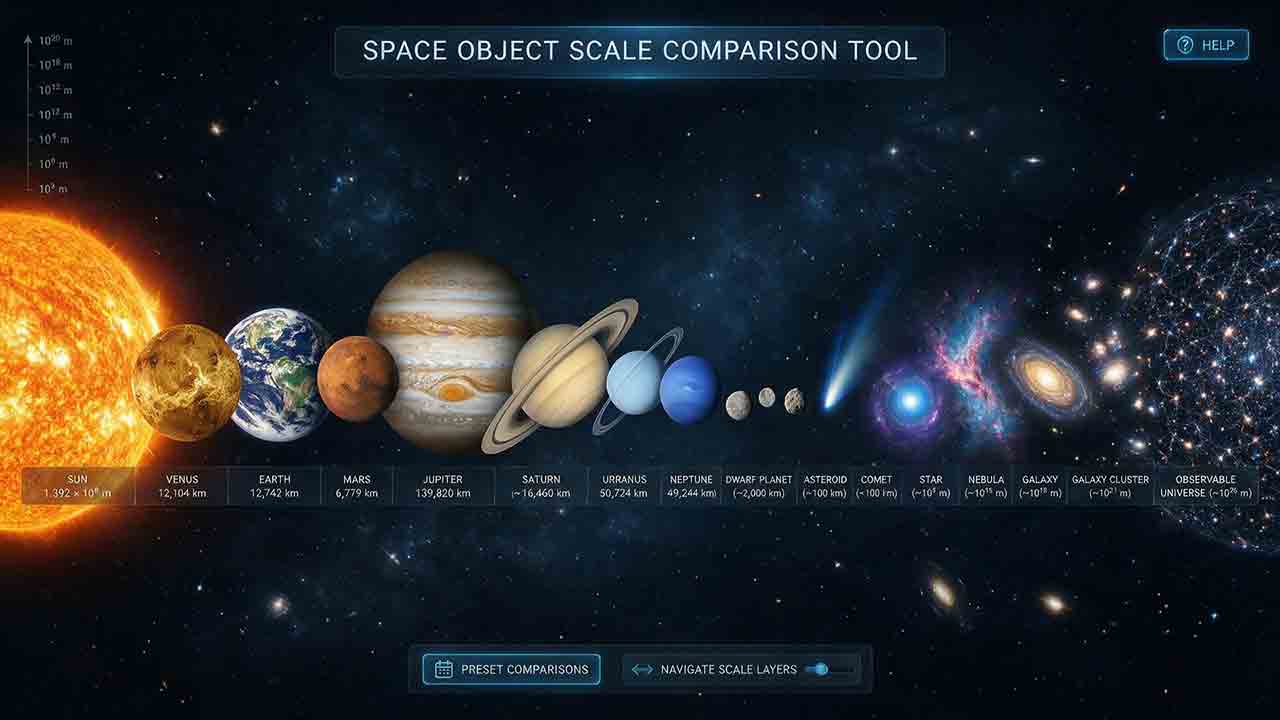
Space Object Scale Comparison Tool
This guide explains how to compare the physical sizes of Bennu, Ceres, Pluto, the Moon, the eight planets, and the Sun on one consistent linear scale. It defines the verified preset objects, distinguishes mean diameter from nominal or approximate width, and shows how to calculate diameter ratios, reference percentages, and scaled model sizes. Original value comes from the Definition–Ratio–Resolution Framework, the Scale-Span Problem, reversible ratio checks, and clear labels for reference-circle area and reference-sphere volume derivations. Worked examples include an Earth-at-10-centimeters model and the visibility limits created by the Sun-to-Bennu size span. The article also explains why rings, comet comae, exoplanets, diffuse nebulae, and black-hole boundaries require custom definitions rather than ordinary planet-diameter presets. Readers gain a practical method for building accurate classroom models, tables, and visualizations without mixing physical size, mass, orbital distance, or angular size.
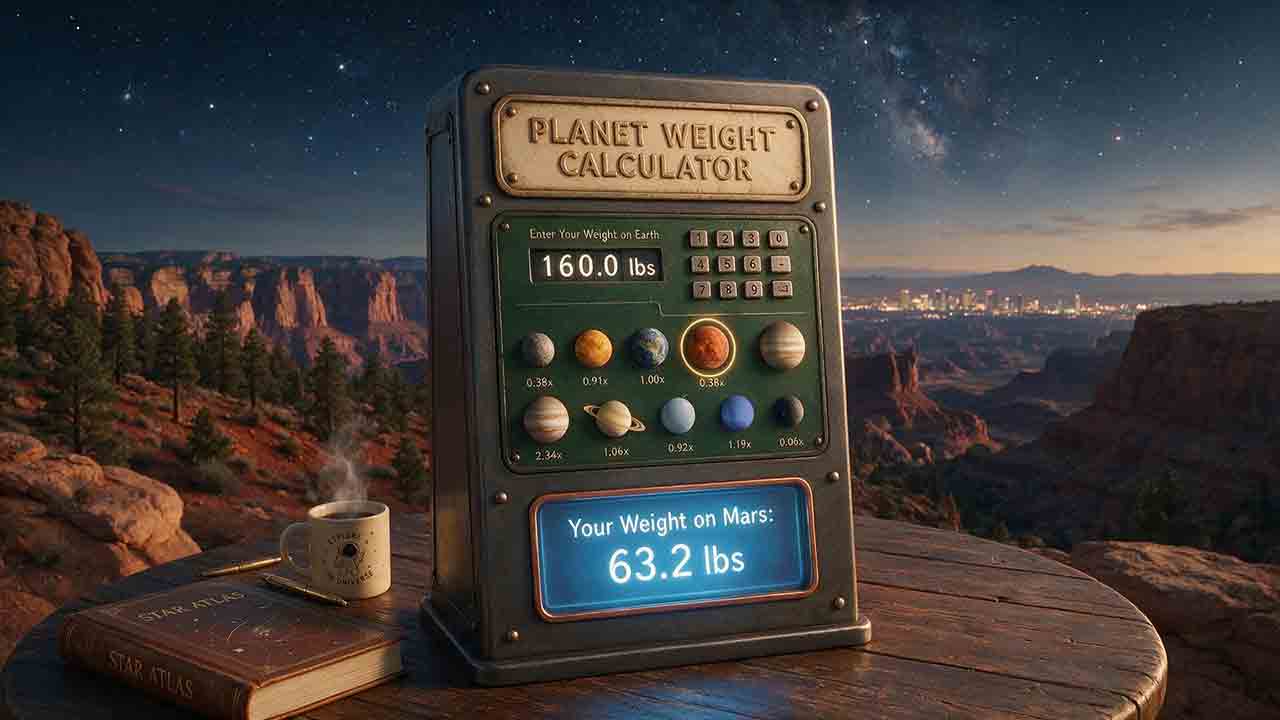
Planet Weight Calculator
This guide explains how a planet weight calculator separates unchanged mass from gravitational force and standard-Earth force equivalents. It shows how to calculate weight with W = mg, interpret kilograms, pound-mass, newtons, pound-force, kg-equivalent, and lb-equivalent, and understand why local scale readings depend on instrument calibration. Sourced gravity presets cover the eight planets, the Moon, and Pluto, with clear warnings for giant planets that have no solid surface. Worked examples, verification values, altitude limits, custom-planet formulas, uncertainty propagation, and the original Reference–Instrument–Support Check help readers evaluate results without confusing force, mass, apparent weight, or reference gravity. The article also explains free fall, reference radii, Pluto data differences, and when a body-specific gravity model is required.
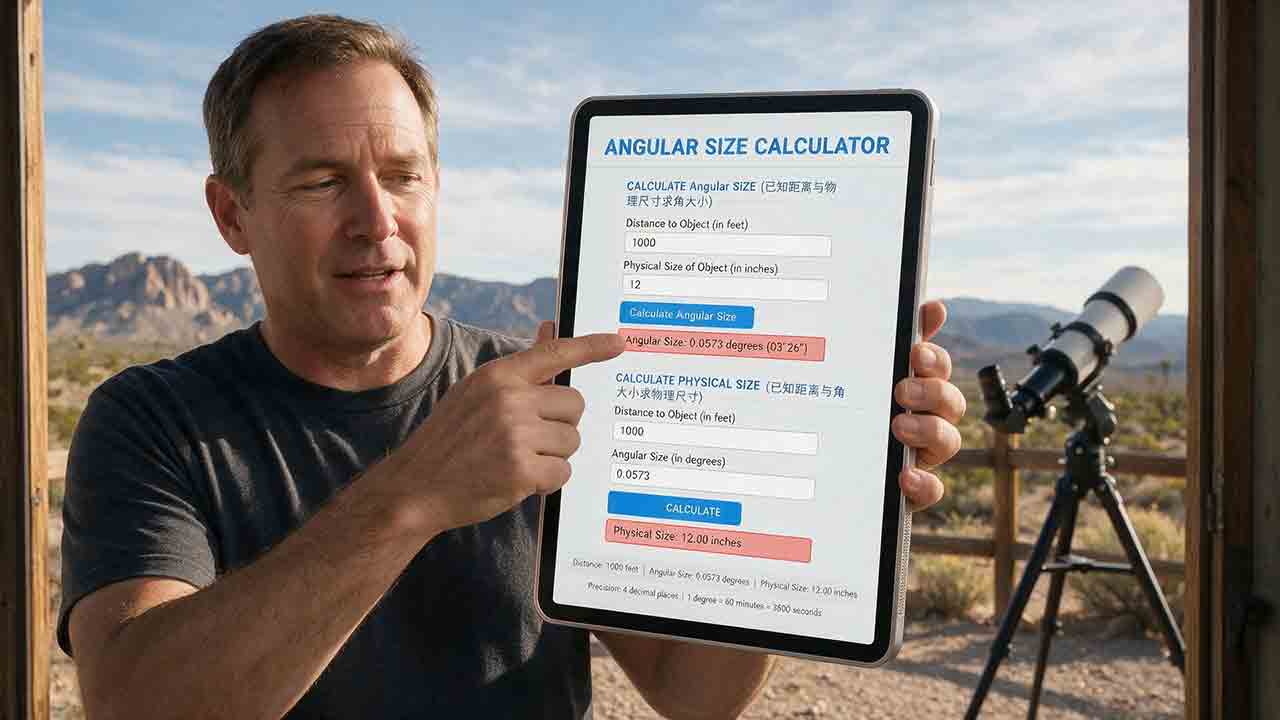
Angular Size Calculator
This guide explains how to calculate angular size, physical size, or distance using projected-width, spherical-limb, and small-angle geometry. It defines the correct distance for a flat projected width, distinguishes center distance for a spherical body, and shows when the small-angle approximation is accurate enough. Readers can verify calculator output with independent test values, a back-calculation check, worked Moon and deep-sky examples, and a reproducible approximation-error table. The article also covers radians, degrees, arcminutes, arcseconds, orientation, field of view, pixel coverage, uncertainty, catalog size differences, and angular-diameter distance in cosmology. Its Geometry–Quantity–Scale check and audit checklist help prevent radius-versus-diameter mistakes, mixed units, incorrect distance inputs, and confusion between angular size, resolution, and field of view.
Explore More Topics
Astrophotography Storage Calculator
This guide explains how to estimate storage for astrophotography capture, processing, and backup without relying on misleading megapixel shortcuts. It compares measured-file, uncompressed-array, and bitrate methods; distinguishes mean, median, high-percentile, and maximum file-size statistics; and explains decimal versus binary storage units. Readers learn how FITS headers, padding, HDUs, RAW compression, calibration frames, RGB conversion, drizzle, mosaics, caches, and temporary files affect project size. Original planning tools include the Four-Bucket Storage Ledger, the Capture–Process–Protect Check, and a clearly defined storage expansion ratio. Worked examples show how to calculate peak logical data, project-relative headroom, complete-copy footprint, media count, write rate, and transfer time. The article also covers integrity verification, backup limitations, retention decisions, and troubleshooting. It is designed to help astrophotographers build realistic capacity plans for single sessions, multi-night projects, planetary video, star trails, and long-term archives.
Star Trail Exposure Calculator
This guide explains how to calculate star-trail exposure time from Earth’s sidereal rotation, stellar declination, and local image scale. It distinguishes polar sweep, declination-adjusted sky-path length, projected pixel length, recorded sweep, missing sweep, and the full start-to-end span of a stacked sequence. Original tables compare trail lengths at several declinations, quantify one-second frame gaps at different image scales, and show how recorded time, gap time, duty cycle, and sequence sweep relate. The Trail–Frame–Sequence Check provides a practical framework for separating celestial geometry, per-frame reliability, and sequence continuity. Worked examples also address the celestial-pole edge case, local WCS-based pixel movement, frame-count limits, long-exposure noise reduction, and the difference between a single exposure and stacked frames. Readers can use the article to plan smoother trails, avoid misleading sequence calculations, and verify expected motion with native-resolution test images.
Camera Field of View Calculator
This guide explains how to calculate horizontal, vertical, and diagonal camera field of view from the recorded active sensor dimensions and effective focal length. It distinguishes physical focal length from crop-factor comparisons, shows why aspect ratio and target rotation affect framing, and provides independently calculated reference tables for common sensor sizes and focal lengths. The original Frame Envelope Check separates ideal frame geometry, the target envelope, and the usable frame retained after dithering, registration, distortion correction, and cropping. Worked examples demonstrate target occupancy, maximum permitted focal length, rotated bounding boxes, and mosaic panel counts with overlap. The article also explains radians versus degrees, crop and stabilization modes, focus breathing, rectilinear versus fisheye projection, and plate-solving verification through a celestial WCS. Readers can use the formulas, margin budget, troubleshooting table, and framing checklist to plan wide-field compositions, small-target imaging, or mosaics without treating a mathematical edge-to-edge fit as a guaranteed final frame.