Planet Weight Calculator

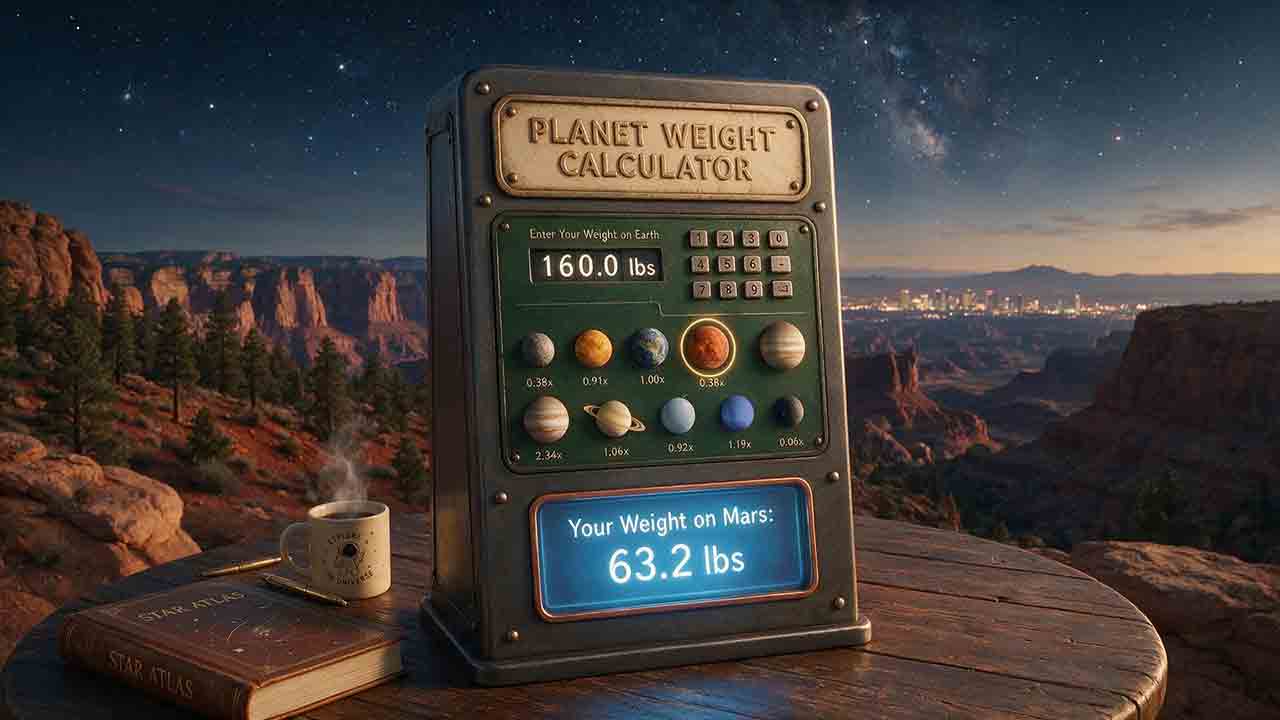
Planet Weight Calculator
A planet weight calculator finds the gravitational force acting on a known mass under another world’s reference gravity. Enter a mass or a standard-Earth comparison value and select a destination. Your mass does not change. The calculator reports force in newtons, a gravity multiplier, and an optional standard-Earth force equivalent—not a new mass or a guaranteed reading from every possible scale.
Key Takeaways
- Mass remains constant when an object moves between planets; gravitational force changes with local (g).
- Scientific weight is a force measured in newtons and calculated with (W=mg).
- A result labeled
kg-equivalentorlb-equivalentis a standard-Earth force comparison, not the object’s mass on the destination world. - A scale designed and calibrated for local gravity can infer the same unchanged mass.
- Jupiter, Saturn, Uranus, and Neptune have no solid surface, so their results describe gravity at a defined reference radius rather than a place where someone could stand.
This guide explains what the calculator computes, how to interpret kilograms and pounds, which gravity references are used, why instrument calibration matters, and where a simple planetary comparison stops being physically complete.
Calculation standard: Force is calculated from (W=mg). Standard-Earth comparison values use the conventional standard gravity (g_n=9.80665\ \text{m/s}^2). Planetary preset values are representative reference accelerations rather than exact gravity at every location. Intermediate calculations are not rounded; displayed results are rounded according to the precision of the input and source values.
Quick interpretation guide
- Mass: unchanged quantity in kilograms or pound-mass.
- Weight force: (W=mg), reported in newtons or pound-force.
- Standard-Earth force equivalent: (W/g_n), reported as kg-equivalent or lb-equivalent.
- Local scale display: depends on the instrument’s design, calibration, acceleration, and support conditions.
What Does the Planet Weight Calculator Calculate?
The core calculator compares a known mass or standard-Earth reference value with preset gravitational accelerations for Solar System bodies.
| Input | Primary output | Optional comparison output |
|---|---|---|
| Mass in kilograms | Weight force in newtons | Standard-Earth kg-equivalent |
| Mass in pound-mass | Weight force in newtons or pound-force | Standard-Earth lb-equivalent |
| Standard-Earth kg comparison | Destination force comparison | kg-equivalent |
| Standard-Earth lb comparison | Destination force comparison | lb-equivalent |
The calculator does not claim that every physical scale placed on another planet would display the comparison value.
A force-measuring scale retaining an Earth-based calibration could convert a changed support force into a lower or higher Earth-equivalent number. A device calibrated for the destination gravity could instead infer the unchanged mass. An ideal comparison balance can also determine mass when both sides experience effectively the same local gravitational field.
Core Preset Scope
The preset comparison covers:
- Mercury
- Venus
- Earth
- Mars
- Jupiter
- Saturn
- Uranus
- Neptune
- the Moon
- Pluto
The Moon is a natural satellite, and Pluto is a dwarf planet. They are included as useful comparison bodies, not as two additional planets.
Altitude corrections and custom-planet calculations are presented later as reproducible reference methods. They should not be assumed to be interactive calculator modes unless the visible tool interface provides those fields.
How Do You Use the Planet Weight Calculator?
Step 1: Identify the Input Quantity
Choose mass mode when the input is a physical mass.
Examples include:
- 70 kg for a person
- 25 kg for scientific equipment
- 1,200 kg for a rover
- 150 lbm for mass expressed in avoirdupois pounds
Choose standard-Earth comparison mode when you want to enter a familiar Earth-based number and compare the force numerically across different gravity references.
In everyday language, people often say they “weigh 70 kilograms.” Scientifically, kilograms measure mass. Under standard gravity, a 70 kg mass has a gravitational weight of approximately 686 newtons.
Step 2: Select the Destination Body
Select the planet, moon, or dwarf planet whose representative gravitational acceleration should be used.
For a solid body, the value is associated with a stated radius near its physical surface. For a giant planet, the calculation uses a reference radius because no hard surface exists.
Step 3: Choose the Output Type
Use:
- newtons for scientific force
- pound-force for force in U.S. customary engineering usage
- gravity multiplier for a compact comparison
- kg-equivalent for a standard-Earth force comparison
- lb-equivalent for a familiar standard-Earth force comparison
A result should not display an unlabeled value such as “56.7 pounds” without identifying whether the quantity is pound-mass, pound-force, or an Earth-referenced equivalent.
Step 4: Check the Assumptions
Before interpreting the result, confirm:
- which gravity value was used
- how its reference radius is defined
- whether the destination has a solid surface
- whether altitude or latitude matters
- whether the object is supported, accelerating, or in free fall
- whether the output is force, mass, or a comparison value
How Are Mass, Weight, and Scale Display Different?
Mass is an intrinsic property of an object and is measured in kilograms.
Weight is a force associated with gravity and is measured in newtons.
NIST’s guidance on mass and weight and SI use of the term weight distinguishes kilograms from newtons.
The basic relationship is:
[
W=mg
]
where:
- (W) is weight force
- (m) is mass
- (g) is the relevant gravitational acceleration
Example: A 70 kg Mass on Earth and Mars
Under standard Earth gravity:
[W_E70\times9.80665]
[W_E686.4655\ \text{N}]
Using the representative Mars value:
[g_{\text{Mars}}3.71\ \text{m/s}^2]
the force is:
[W_{\text{Mars}}70\times3.71]
[W_{\text{Mars}}259.7\ \text{N}]
The mass remains 70 kg. Only the calculated gravitational force changes.
What Does “Standard-Earth Force Equivalent” Mean?
A standard-Earth force equivalent answers:
What mass would produce the same force under the conventional standard gravity (g_n)?
It is defined as:
[m_{\text{SE}}\frac{W}{g_n}]
where:
[g_n9.80665\ \text{m/s}^2]
Because:
[W=mg_p]
the equivalent can also be written as:
[m_{\text{SE}}m\frac{g_p}{g_n}]
For a 70 kg mass using the representative Mars gravity:
[m_{\text{SE}}\frac{259.7}{9.80665}]
[m_{\text{SE}}\approx26.5\ \text{kg-equivalent}]
This means that 259.7 N is approximately the force produced by a 26.5 kg mass under standard Earth gravity.
It does not mean:
- the person’s mass has become 26.5 kg
- every scale on Mars would display 26.5 kg
- a Mars-calibrated instrument would report an incorrect mass
- motion, buoyancy, or atmospheric effects have been included
Why Does Scale Calibration Matter?
A force-measuring scale that retains an Earth-based calibration may interpret the weaker Mars support force as a lower Earth-equivalent number.
A scale designed to infer mass under the selected Mars gravity could calculate:
[m\frac{W}{g_{\text{Mars}}}]
[m\frac{259.7}{3.71}]
[m70\ \text{kg}]
An ideal balance comparing an unknown mass with known masses can also recover the same mass when both sides experience effectively the same local gravity and other influences, such as buoyancy, are negligible or corrected.
The calculator therefore labels the comparison as a standard-Earth force equivalent, not “your new mass” and not a universal scale prediction.
What Do lbm, lbf, and lb-Equivalent Mean?
The word “pound” is ambiguous unless the physical quantity is identified.
| Label | Quantity | Relationship |
|---|---|---|
| lbm | pound-mass | (1\ \text{lbm}=0.45359237\ \text{kg}) |
| lbf | pound-force | (1\ \text{lbf}=4.4482216152605\ \text{N}) |
| lb-equivalent | Standard-Earth force comparison | Force expressed as the lbm that would produce the same force under (g_n) |
NIST’s conversion-factor footnotes distinguish the avoirdupois pound from pound-force.
The Same-Number Trap
Under standard gravity, a mass of 150 lbm has a standard weight of 150 lbf. The numerical values match by convention, but the quantities are different:
- 150 lbm is mass
- 150 lbf is force
Using representative Mars gravity, the same 150 lbm mass has a calculated force of approximately:
[56.7\ \text{lbf}]
Its standard-Earth force equivalent is also numerically:
[56.7\ \text{lb-equivalent}]
The matching numbers do not make pound-force and pound-mass the same physical unit.
Which Gravity Values Does the Calculator Use?
The preset table uses NASA/JPL equatorial gravity values for the planets and Pluto. Standard gravity is used as the denominator for Earth-referenced comparisons.
NASA/JPL presents the listed values as equatorial gravitational accelerations associated with its planetary mass and equatorial-radius data. These values are suitable for reference comparisons, but they are not complete local effective-gravity models.
| Body | Reference gravity (g) | Standard-Earth multiplier (g/g_n) | 100-unit comparison | Reference interpretation |
|---|---|---|---|---|
| Mercury | (3.70\ \text{m/s}^2) | 0.3773 | 37.73 | Equatorial reference near a solid surface |
| Venus | (8.87\ \text{m/s}^2) | 0.9045 | 90.45 | Equatorial reference near a solid surface |
| Earth | (9.80665\ \text{m/s}^2) | 1.0000 | 100.00 | Conventional standard-gravity reference |
| Mars | (3.71\ \text{m/s}^2) | 0.3783 | 37.83 | Equatorial reference near a solid surface |
| Jupiter | (24.79\ \text{m/s}^2) | 2.5279 | 252.79 | Equatorial reference-radius value; no solid surface |
| Saturn | (10.44\ \text{m/s}^2) | 1.0646 | 106.46 | Equatorial reference-radius value; no solid surface |
| Uranus | (8.87\ \text{m/s}^2) | 0.9045 | 90.45 | Equatorial reference-radius value; no solid surface |
| Neptune | (11.15\ \text{m/s}^2) | 1.1370 | 113.70 | Equatorial reference-radius value; no solid surface |
| Moon | (1.62\ \text{m/s}^2) | 0.1652 | 16.52 | Representative solid-surface value |
| Pluto | (0.62\ \text{m/s}^2) | 0.0632 | 6.32 | JPL equatorial reference near a solid surface |
The planetary and Pluto values come from the NASA/JPL Planetary Physical Parameters table. The Moon comparison is consistent with NIST’s discussion of local gravitational acceleration.
Why Is Earth Set to 9.80665 Rather Than 9.80?
NASA/JPL lists an approximate Earth equatorial gravity of:
[9.80\ \text{m/s}^2]
The calculator instead uses the conventional standard gravity:
[g_n9.80665\ \text{m/s}^2]
for standard-Earth comparisons.
This makes the Earth comparison multiplier exactly:
[1.0000]
under the stated convention. It does not mean that local gravity is exactly (9.80665\ \text{m/s}^2) everywhere on Earth.
Why Can Published Pluto Gravity Values Differ?
NASA and NASA/JPL pages can show different rounded values for Pluto’s gravity. The NASA/JPL physical-parameter table and the NASA NSSDC Pluto Fact Sheet give approximately:
[0.62\ \text{m/s}^2]
Other public comparison materials may show a different rounded value.
This calculator uses (0.62\ \text{m/s}^2) so that the Pluto preset follows the same NASA/JPL parameter source used for the planetary table.
The cited pages do not establish one documented explanation for every difference between public-facing values. Differences may involve rounding, adopted parameters, or reference conventions, but a specific cause should not be asserted unless the source identifies it.
How Is a Standard-Earth Comparison Converted?
For a numerical standard-Earth comparison (R_E):
[R_pR_E\frac{g_p}{g_n}]
where:
- (R_p) is the destination’s standard-Earth force equivalent
- (R_E) is the entered Earth-reference comparison
- (g_p) is the destination reference gravity
- (g_n) is conventional standard gravity
Example: A 150 lb Comparison on Mars
[R_{\text{Mars}}150\times\frac{3.71}{9.80665}]
[R_{\text{Mars}}\approx56.7\ \text{lb-equivalent}]
The associated force is approximately:
[56.7\ \text{lbf}]
or:
[252\ \text{N}]
The object’s mass remains 150 lbm, or approximately 68.0 kg.
Example: A 150 lb Comparison at Neptune’s Reference Radius
[R_{\text{Neptune}}150\times\frac{11.15}{9.80665}]
[R_{\text{Neptune}}\approx170.5\ \text{lb-equivalent}]
This is a force comparison at Neptune’s reference radius, not a prediction of standing on a solid Neptune surface.
How Is Weight Force Calculated in Newtons?
When mass is known:
[W=mg]
Example: A 25 kg Instrument on Mercury
[W25\times3.70]
[W92.5\ \text{N}]
Its standard-Earth force equivalent is:
[\frac{92.5}{9.80665}\approx9.43\ \text{kg-equivalent}]
The instrument’s mass remains 25 kg.
Example: A 25 kg Instrument at Jupiter’s Reference Radius
[W25\times24.79]
[W619.75\ \text{N}]
The standard-Earth force equivalent is:
[\frac{619.75}{9.80665}\approx63.2\ \text{kg-equivalent}]
This is a reference-radius calculation for a planet without a solid surface.
Planet Weight Comparison for a 70 kg Mass
| Body | Unchanged mass | Weight force | Standard-Earth force equivalent |
|---|---|---|---|
| Mercury | 70 kg | 259.0 N | 26.4 kg-equivalent |
| Venus | 70 kg | 620.9 N | 63.3 kg-equivalent |
| Earth | 70 kg | 686.5 N | 70.0 kg-equivalent |
| Mars | 70 kg | 259.7 N | 26.5 kg-equivalent |
| Jupiter | 70 kg | 1,735.3 N | 177.0 kg-equivalent |
| Saturn | 70 kg | 730.8 N | 74.5 kg-equivalent |
| Uranus | 70 kg | 620.9 N | 63.3 kg-equivalent |
| Neptune | 70 kg | 780.5 N | 79.6 kg-equivalent |
| Moon | 70 kg | 113.4 N | 11.6 kg-equivalent |
| Pluto | 70 kg | 43.4 N | 4.43 kg-equivalent |
The mass column does not change. The last column is a standard-Earth force comparison, not a local measurement of mass.
Which Result Should You Use?
| Purpose | Recommended output | Reason |
|---|---|---|
| General comparison | Gravity multiplier and labeled equivalent | Easy to interpret |
| Physics education | Mass, gravity, and force in newtons | Separates the physical quantities |
| Engineering estimate | Force in newtons with reference definition | Avoids ambiguous scale language |
| U.S. customary force | Pound-force | Identifies force explicitly |
| Classroom “what would I weigh?” question | kg-equivalent or lb-equivalent with a definition | Familiar without claiming mass changed |
| Custom-planet analysis | Model gravity and propagated uncertainty | Reflects source assumptions |
Recommended Result Format
A clear result should look like this:
Mass: 70 kg
Reference gravity: 3.71 m/s²
Weight force: 259.7 N
Standard-Earth force equivalent: 26.5 kg-equivalent
Interpretation: A scale designed to infer mass under the selected Mars gravity could still report 70 kg.
This format is less ambiguous than displaying “26.5 kg” alone.
Why Does Jupiter Not Produce 318 Times Earth Weight?
Jupiter has roughly 318 times Earth’s mass, but its listed reference gravity is only about 2.53 times standard Earth gravity.
Gravity at a chosen reference radius depends on both mass and radius:
[g\frac{GM}{R^2}]
where:
- (G) is the gravitational constant
- (M) is the body’s mass
- (R) is the reference distance from its center
Jupiter’s large radius places the reference level much farther from its center than Earth’s surface is from Earth’s center. Because radius is squared in the denominator, planetary mass alone does not determine reference-level gravity.
The Mass–Radius Balance
When a planet and Earth are evaluated using internally consistent modeled masses and radii:
[\frac{g_p}{g_{E,\mathrm{model}}}\frac{M_p/M_E}{(R_p/R_E)^2}]
Here:
[g_{E,\mathrm{model}}\frac{GM_E}{R_E^2}]
is the Earth gravity implied by the selected Earth mass and radius values.
It is not automatically identical to:
[g_n9.80665\ \text{m/s}^2]
because (g_n) is a conventional standard value rather than a gravity derived from an arbitrary chosen Earth radius and mass dataset.
A world can therefore be:
- much more massive but only moderately stronger in reference gravity
- smaller but relatively dense
- large and low in average density
- similar in gravity despite having a different mass and radius
This also explains why Mercury and Mars have similar reference gravities even though their physical properties differ.
What Does “Weight on Jupiter” Mean?
Jupiter and Saturn are gas giants, while Uranus and Neptune are ice giants. NASA states that these worlds do not have true solid surfaces.
The preset result should therefore be interpreted as:
the gravitational force calculated using the equatorial reference-radius value in the cited parameter table.
It is not a literal standing-weight prediction.
NASA’s fact pages explain the lack of a true solid surface for Jupiter, Saturn, Uranus, and Neptune.
The simple calculation does not include:
- atmospheric buoyancy
- pressure
- winds
- fluid motion
- changing density with depth
- probe descent dynamics
- survivability
- gravity inside the reference radius
How Do Altitude and Free Fall Affect Weight?
This section provides a reference method rather than promising a separate altitude mode in the interactive calculator.
The following altitude relationship is a central-body approximation. It assumes that the body can be treated as spherically symmetric, that the observation point is outside the relevant mass distribution, and that (h) is measured radially outward from the same reference radius (R) at which (g_0) is defined.
The model neglects planetary oblateness, rotation, latitude-dependent centrifugal effects, local geology, topography, atmospheric buoyancy, tides, and gravitational effects from other bodies. For precise work near a non-spherical planet or moon, use a body-specific gravity model rather than this single inverse-square expression.
Under those assumptions:
[g(h)g_0\left(\frac{R}{R+h}\right)^2]
where:
- (g_0) is the gravitational acceleration at reference radius (R)
- (R) is measured from the body’s center
- (h) is radial altitude above that reference radius
- (R+h) is the new center-to-object distance
The corresponding gravitational force is:
[W(h)mg(h)]
Example: 400 km Above Earth
Using an approximate mean Earth radius of 6,371 km:
[\frac{g(h)}{g_0}\left(\frac{6{,}371}{6{,}371+400}\right)^2]
[\approx0.885]
The spherical inverse-square estimate is therefore about 88.5% of the reference value used at the starting radius.
This percentage is an idealized gravity-ratio calculation. It does not include Earth’s oblateness, rotation, latitude, local gravity anomalies, or atmospheric forces.
Astronauts in low Earth orbit experience apparent weightlessness because the spacecraft and occupants are falling together. Gravity has not disappeared.
Gravitational Weight Versus Apparent Weight
A scale measures support force rather than gravity in isolation.
Apparent scale weight can differ from (mg) when an object is:
- accelerating in an elevator
- in orbital free fall
- supported in a rotating habitat
- immersed in a fluid
- exposed to aerodynamic forces
- standing on an accelerating vehicle
The core calculator reports static gravitational force. It does not simulate every contact, buoyancy, or acceleration force.
How Can You Estimate Gravity on a Custom Planet?
This is a reproducible reference calculation. It should not be treated as a promised interactive mode unless the page interface contains custom mass and radius inputs.
For an approximately spherical world:
[g_p\frac{GM_p}{R_p^2}]
If the planet’s mass and radius are given in Earth units:
[\frac{g_p}{g_{E,\mathrm{model}}}\frac{M_p/M_E}{(R_p/R_E)^2}]
The denominator (g_{E,\mathrm{model}}) means the Earth gravity calculated from the same selected Earth mass and radius reference:
[g_{E,\mathrm{model}}\frac{GM_E}{R_E^2}]
It should not be silently replaced with standard gravity (g_n).
Example: A Hypothetical Exoplanet
Suppose a planet has:
- (2.0) Earth masses
- (1.4) Earth radii
Then:
[\frac{g_p}{g_{E,\mathrm{model}}}\frac{2.0}{1.4^2}]
[\approx1.0204]
The result means that the modeled planet gravity is approximately 1.02 times the modeled Earth gravity derived from the same mass-and-radius convention.
It does not yet establish an exact standard-Earth force-equivalent multiplier.
To calculate that multiplier:
[\frac{g_p}{g_n}\frac{g_p}{g_{E,\mathrm{model}}}\frac{g_{E,\mathrm{model}}}{g_n}]
Therefore:
[m_{\text{SE}}m\frac{g_p}{g_n}]
A standard-Earth equivalent should only be reported after (g_{E,\mathrm{model}}), or (g_p) directly, has been specified consistently.
This calculation does not determine atmospheric conditions, habitability, rotation effects, or the existence of a solid surface.
How Does Uncertainty Affect a Custom-Planet Estimate?
For:
[g\frac{GM}{R^2}]
and approximately independent mass and radius uncertainties:
[\left(\frac{\sigma_g}{g}\right)^2\approx\left(\frac{\sigma_M}{M}\right)^2
+\left(2\frac{\sigma_R}{R}\right)^2]
If mass uncertainty is 10% and radius uncertainty is 5%:
[\frac{\sigma_g}{g}\approx\sqrt{0.10^2+(2\times0.05)^2}]
[\approx0.14]
The estimated gravity uncertainty is approximately 14%.
A result such as:
[1.020408163]
would imply unjustified physical precision when the input uncertainties are this large.
What Is the Reference–Instrument–Support Check?
Before interpreting a result, answer three questions.
1. Reference
Where is the gravitational acceleration defined?
Possibilities include:
- equatorial radius
- mean radius
- a local surface site
- a specified altitude
- a giant-planet mathematical reference radius
2. Instrument
What does the measuring device determine?
Examples include:
- force through a spring or load cell
- mass inferred from locally calibrated force
- mass by comparison with standards
- apparent support force during acceleration
3. Support State
Is the object:
- resting on a surface
- suspended from a support
- accelerating
- floating in a fluid
- orbiting in free fall
This three-part check is more reliable than treating one gravity multiplier as a complete prediction of every weighing situation.
Which Values Can Verify the Calculator?
| Test | Expected result |
|---|---|
| 1 kg under standard gravity | exactly 9.80665 N under the stated convention |
| 10 kg using Mars gravity (3.71) | 37.1 N |
| 100 Earth-equivalent units on Mercury | approximately 37.7295 units |
| 100 Earth-equivalent units on Venus | approximately 90.4488 units |
| 100 Earth-equivalent units on Jupiter | approximately 252.7876 units |
| 100 Earth-equivalent units on Saturn | approximately 106.4584 units |
| 100 Earth-equivalent units on Uranus | approximately 90.4488 units |
| 100 Earth-equivalent units on Neptune | approximately 113.6984 units |
| 100 Earth-equivalent units on Pluto | approximately 6.3222 units |
| Zero mass | zero force |
| Double mass at fixed gravity | double force |
| Double gravity at fixed mass | double force |
The extended decimals are intended for implementation testing using the stated rounded preset values. They are not claims that the underlying planetary acceleration is known to the same number of digits.
User-facing values should normally be rounded to match the precision of the selected reference gravity and the entered mass.
Force-Equivalent Consistency Test
For a mass (m):
[m\rightarrowW=mg_p\rightarrowm_{\text{SE}}=\frac{W}{g_n}]
should give:
[m_{\text{SE}}m\frac{g_p}{g_n}]
For a 70 kg mass using representative Mars gravity:
[70\rightarrow259.7\ \text{N}\rightarrow26.48\ \text{kg-equivalent}]
The last value is an Earth-force equivalent. It is not expected to recover the original mass because the force was calculated under a different gravity.
Earth Identity Test
When the calculator’s Earth comparison uses (g_n):
[m\rightarrowmg_n\rightarrow\frac{mg_n}{g_n}m]
The standard-Earth equivalent must return the original mass before display rounding.
Custom-Planet Reference Test
For a custom planet defined in Earth mass and radius units, the implementation should first verify:
[\frac{g_p}{g_{E,\mathrm{model}}}\frac{M_p/M_E}{(R_p/R_E)^2}]
It should then convert to a standard-Earth comparison using:
[\frac{g_p}{g_n}\frac{g_p}{g_{E,\mathrm{model}}}\frac{g_{E,\mathrm{model}}}{g_n}]
This prevents accidental treatment of (g_{E,\mathrm{model}}) and (g_n) as interchangeable constants.
Common Planet Weight Errors and Troubleshooting
| Problem | Likely cause | What to check |
|---|---|---|
| Mass changes between planets | Mass and weight were confused | Keep mass constant |
| A kg result is labeled as force | Mass-equivalent and force were mixed | Use newtons for force |
| “Pounds” is ambiguous | lbm, lbf, and lb-equivalent were not separated | Label the quantity explicitly |
| Mars result is presented as a universal scale display | Instrument calibration was ignored | Describe it as a standard-Earth force equivalent |
| Jupiter result is treated as standing weight | A solid surface was assumed | Label it as reference-radius gravity |
| Earth does not return the input value | Different Earth references were mixed | Use (g_n) consistently in standard-Earth mode |
| Custom-planet ratio is slightly inconsistent | (g_{E,\mathrm{model}}) was replaced by (g_n) | Keep modeled and conventional Earth references separate |
| Altitude estimate is treated as exact local gravity | Spherical inverse-square assumptions were overlooked | Check rotation, oblateness, latitude, and local gravity models |
| Pluto differs from another public page | Different source values were selected | State which source and value the calculator uses |
| Orbit is described as zero gravity | Free fall was confused with no gravitational force | Separate gravity from support-force sensation |
| Altitude has no effect | The reference value was reused without correction | Apply the inverse-square estimate where appropriate |
| Custom-planet result has too many digits | Mass and radius uncertainty were ignored | Propagate uncertainty |
| Venus and Uranus give the same preset multiplier | Both presets use (8.87\ \text{m/s}^2) | Similar gravity does not imply similar environments |
| A negative or non-finite input is accepted | Input validation is incomplete | Reject negative mass, NaN, and infinity |
Planet Weight Result Audit Checklist
Before publishing or relying on a result, confirm:
- The input is identified as mass or a standard-Earth comparison.
- Kilograms and pound-mass are not labeled as force.
- Weight force is reported in newtons or pound-force.
- Every kg-equivalent or lb-equivalent result is defined clearly.
- Instrument calibration is not assumed without explanation.
- The standard-Earth denominator is (g_n).
- Modeled Earth gravity (g_{E,\mathrm{model}}) is not silently replaced with (g_n).
- Planetary values have an identified source and reference convention.
- Giant-planet results are not described as standing on solid ground.
- The Moon and Pluto are not classified as planets.
- Pluto’s selected value is stated without inventing a cause for disagreements between sources.
- Altitude calculations state the spherical inverse-square assumptions.
- Rotation, oblateness, latitude, local gravity anomalies, and other bodies are considered when precision requires them.
- Acceleration, support conditions, and free fall are considered when relevant.
- Custom-planet uncertainty is reflected in the displayed precision.
- Extended test digits are not presented as observational accuracy.
- Described calculator modes match the visible interface.
- Results are not presented as medical, structural, or mission-safety advice.
Practical Conclusion
Use the planet weight calculator to find the gravitational force on a known mass and compare that force with conventional standard Earth gravity. For scientific work, keep the mass unchanged and report (W=mg) in newtons. For an accessible comparison, use a clearly labeled standard-Earth force equivalent.
Students should display mass, force, and comparison value together. General readers should treat kg-equivalent and lb-equivalent as explanatory comparisons rather than new mass values. Engineers should use a defined local or mission-specific gravity model. Custom-planet calculations should keep modeled Earth gravity separate from (g_n) and include mass-and-radius uncertainty.
Use the altitude formula only as a spherical central-body approximation. Precision work around an oblate, rotating, geologically uneven, or strongly perturbed body requires an appropriate gravity-field model.
Scope notice: This calculator is intended for education, comparison, and preliminary estimation. Medical decisions, structural design, spacecraft operations, and mission navigation require validated measurements and specialist models.
Related Space Distance and Scale Tools
- Astronomical Distance Converter — convert planetary radii, altitudes, and other distance inputs into compatible units.
- Angular Size Calculator — calculate how large a planet or moon appears from a known distance.
- Planet Distance Calculator — compare observer-to-planet distances for a selected context.
- Solar System Scale Calculator — create proportional models of planetary sizes and separations.
Frequently Asked Questions
Does My Mass Change on Another Planet?
No. Mass remains the same.
A 70 kg object remains 70 kg on Mars, Jupiter, or the Moon, while its gravitational weight force changes with the selected (g).
Would a Scale on Mars Show a Lower Number?
It depends on the instrument and calibration.
An Earth-calibrated force scale could show a lower Earth-equivalent value. A scale designed to infer mass using Mars gravity could still report 70 kg for a 70 kg mass.
How Much Is a 150 lb Standard-Earth Comparison on Mars?
Using:
[g_{\text{Mars}}3.71\ \text{m/s}^2]
the standard-Earth force equivalent is approximately 56.7 lb-equivalent.
The associated force is approximately 56.7 lbf, while the object’s mass remains 150 lbm.
Why Is Weight Measured in Newtons?
Weight is a force, and the SI unit of force is the newton.
Kilograms measure mass. A kilogram-equivalent result is only a force comparison referenced to standard gravity.
Can Someone Stand on Jupiter and Weigh 2.53 Times More?
No. Jupiter has no true solid surface.
The multiplier describes gravity at the reference radius used in the cited parameter data, not a survivable standing location.
Why Do Astronauts Feel Weightless While Gravity Is Present?
Astronauts and their spacecraft are in continuous free fall together.
The support force that a scale would measure becomes very small even though Earth’s gravitational attraction remains substantial.
Sources
NIST — Guide to the SI, Chapter 8: Weight
Defines weight as force and identifies the newton as its SI unit. Accessed August 1, 2026.NIST — SI Units: Mass
Explains the distinction between mass in kilograms and weight as gravitational force. Accessed August 1, 2026.NIST — Standard Acceleration of Free Fall
Lists the conventional standard gravity (g_n=9.80665\ \text{m/s}^2). Accessed August 1, 2026.BIPM — Declaration on Mass, Weight, and Standard Gravity
Official declaration distinguishing the kilogram as mass from weight as force and establishing standard gravity. Accessed August 1, 2026.NASA/JPL Solar System Dynamics — Planetary Physical Parameters
Provides planetary and dwarf-planet masses, radii, and equatorial gravity values used by the preset table. Accessed August 1, 2026.NASA Glenn Research Center — Weight Equation
Explains (W=mg), the inverse-square dependence on center distance, altitude effects, and apparent weight during orbital free fall. Accessed August 1, 2026.NASA Science — Basics of Spaceflight Glossary
Defines gravitational acceleration as (g=GM/r^2), with (r) measured from the primary body’s center. Accessed August 1, 2026.OpenStax University Physics — Gravitation Near Earth’s Surface
Explains that the point-mass inverse-square form applies outside a spherically symmetric mass distribution and discusses departures caused by Earth’s non-spherical shape and rotation. Accessed August 1, 2026.NASA Space Place — How Do We Weigh Planets?
Educational comparison of mass and weight on different planets. Accessed August 1, 2026.NASA Science — Jupiter Facts
Explains that Jupiter does not have a true solid surface. Accessed August 1, 2026.NASA Science — Saturn Facts
Explains that Saturn does not have a true solid surface. Accessed August 1, 2026.NASA Science — Uranus Facts
Explains that Uranus does not have a true solid surface. Accessed August 1, 2026.NASA Science — Neptune Facts
Explains that Neptune does not have a solid surface. Accessed August 1, 2026.NASA NSSDC — Pluto Fact Sheet
Lists Pluto’s mean and equatorial surface gravity as approximately (0.62\ \text{m/s}^2). Accessed August 1, 2026.NIST — Conversion-Factor Footnotes
Provides the exact avoirdupois-pound and pound-force conversion conventions. Accessed August 1, 2026.
More from Space Distance & Scale Tools
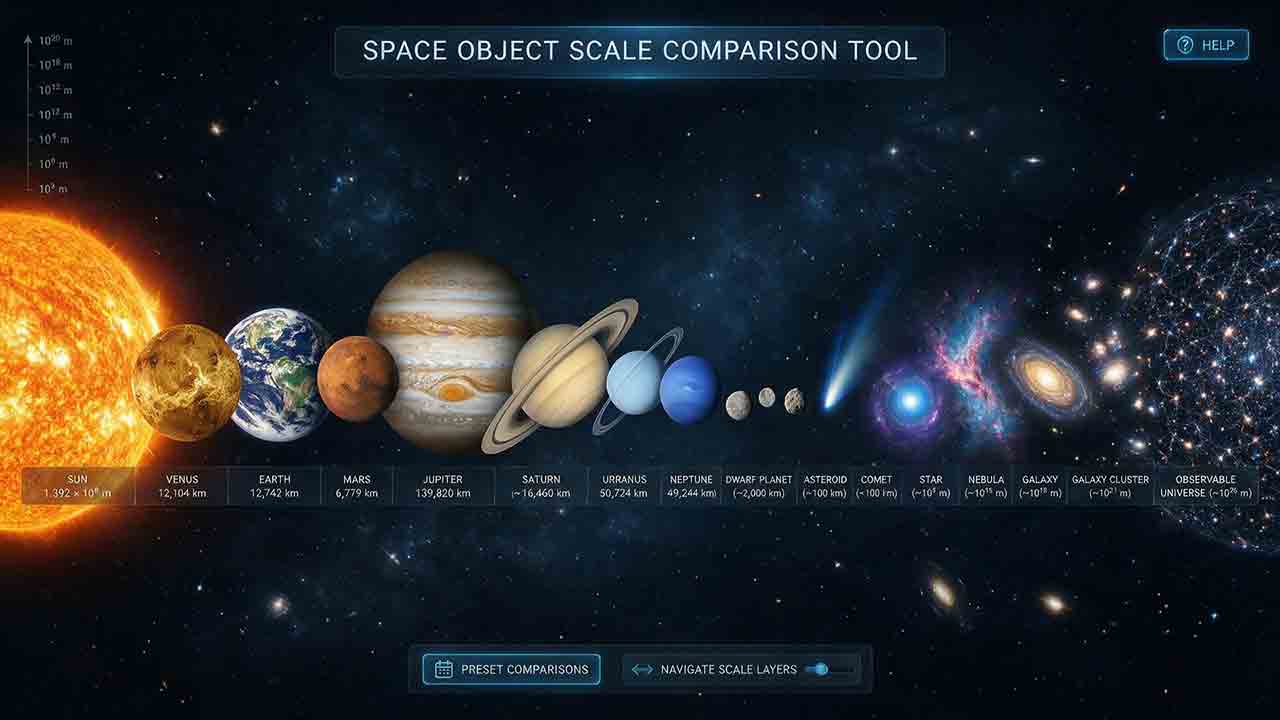
Space Object Scale Comparison Tool
This guide explains how to compare the physical sizes of Bennu, Ceres, Pluto, the Moon, the eight planets, and the Sun on one consistent linear scale. It defines the verified preset objects, distinguishes mean diameter from nominal or approximate width, and shows how to calculate diameter ratios, reference percentages, and scaled model sizes. Original value comes from the Definition–Ratio–Resolution Framework, the Scale-Span Problem, reversible ratio checks, and clear labels for reference-circle area and reference-sphere volume derivations. Worked examples include an Earth-at-10-centimeters model and the visibility limits created by the Sun-to-Bennu size span. The article also explains why rings, comet comae, exoplanets, diffuse nebulae, and black-hole boundaries require custom definitions rather than ordinary planet-diameter presets. Readers gain a practical method for building accurate classroom models, tables, and visualizations without mixing physical size, mass, orbital distance, or angular size.
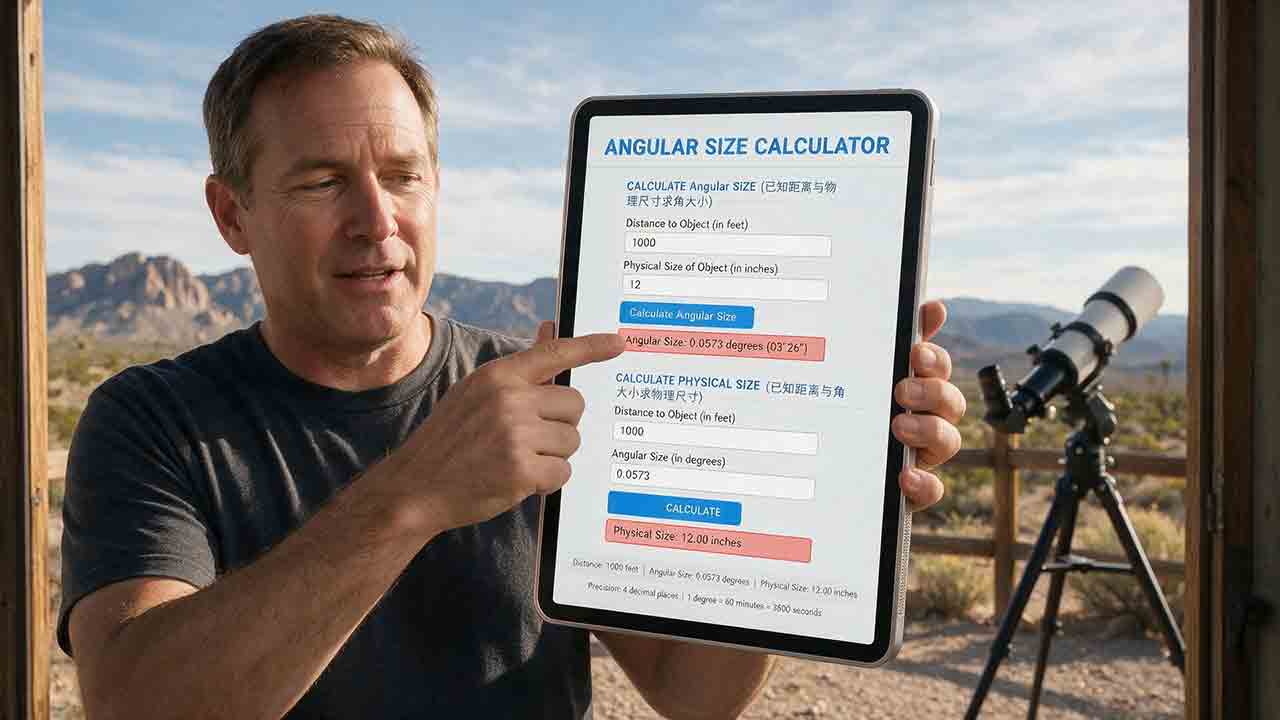
Angular Size Calculator
This guide explains how to calculate angular size, physical size, or distance using projected-width, spherical-limb, and small-angle geometry. It defines the correct distance for a flat projected width, distinguishes center distance for a spherical body, and shows when the small-angle approximation is accurate enough. Readers can verify calculator output with independent test values, a back-calculation check, worked Moon and deep-sky examples, and a reproducible approximation-error table. The article also covers radians, degrees, arcminutes, arcseconds, orientation, field of view, pixel coverage, uncertainty, catalog size differences, and angular-diameter distance in cosmology. Its Geometry–Quantity–Scale check and audit checklist help prevent radius-versus-diameter mistakes, mixed units, incorrect distance inputs, and confusion between angular size, resolution, and field of view.
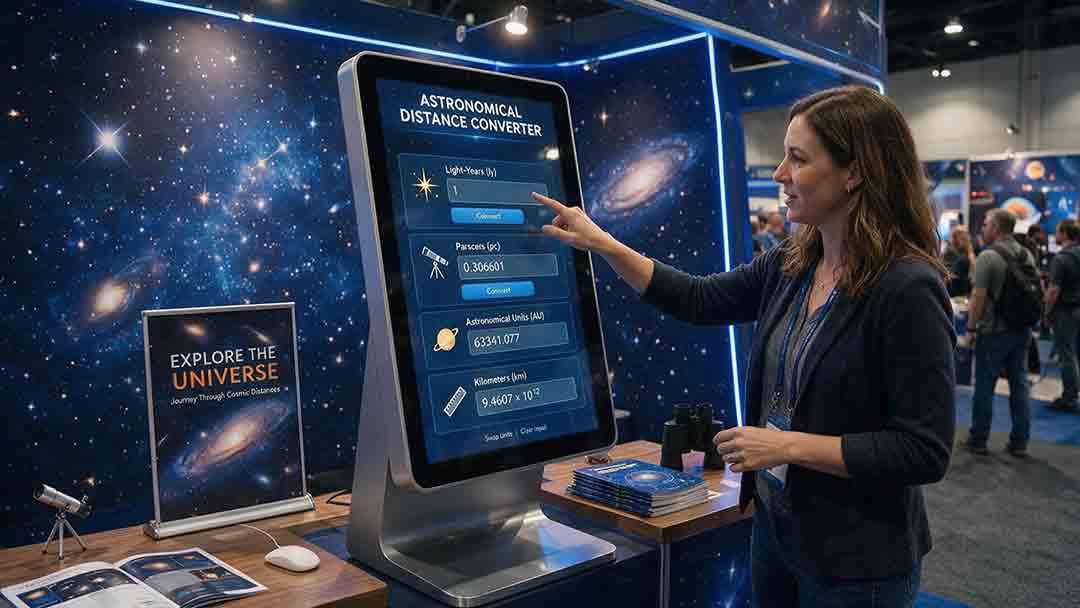
Astronomical Distance Converter
This article explains how to convert astronomical distances among meters, kilometers, international miles, astronomical units, light-seconds, light-minutes, light-hours, light-days, light-years, parsecs, kiloparsecs, megaparsecs, and gigaparsecs. It presents the common-base conversion formula, authoritative unit definitions, implementation test values, and a back-conversion check for verifying calculator accuracy. Readers also learn how to choose an appropriate unit with the Scale–Purpose–Precision framework, preserve significant figures, propagate uncertainty, and distinguish exact conversion constants from uncertain astronomical measurements. Worked examples cover Earth–Moon, stellar, and galactic scales, while the troubleshooting table addresses common prefix, rounding, and unit errors. The guide also clarifies why unit conversion alone cannot determine a planet’s current distance or turn redshift directly into a cosmological distance.
Explore More Topics
Astrophotography Storage Calculator
This guide explains how to estimate storage for astrophotography capture, processing, and backup without relying on misleading megapixel shortcuts. It compares measured-file, uncompressed-array, and bitrate methods; distinguishes mean, median, high-percentile, and maximum file-size statistics; and explains decimal versus binary storage units. Readers learn how FITS headers, padding, HDUs, RAW compression, calibration frames, RGB conversion, drizzle, mosaics, caches, and temporary files affect project size. Original planning tools include the Four-Bucket Storage Ledger, the Capture–Process–Protect Check, and a clearly defined storage expansion ratio. Worked examples show how to calculate peak logical data, project-relative headroom, complete-copy footprint, media count, write rate, and transfer time. The article also covers integrity verification, backup limitations, retention decisions, and troubleshooting. It is designed to help astrophotographers build realistic capacity plans for single sessions, multi-night projects, planetary video, star trails, and long-term archives.
Star Trail Exposure Calculator
This guide explains how to calculate star-trail exposure time from Earth’s sidereal rotation, stellar declination, and local image scale. It distinguishes polar sweep, declination-adjusted sky-path length, projected pixel length, recorded sweep, missing sweep, and the full start-to-end span of a stacked sequence. Original tables compare trail lengths at several declinations, quantify one-second frame gaps at different image scales, and show how recorded time, gap time, duty cycle, and sequence sweep relate. The Trail–Frame–Sequence Check provides a practical framework for separating celestial geometry, per-frame reliability, and sequence continuity. Worked examples also address the celestial-pole edge case, local WCS-based pixel movement, frame-count limits, long-exposure noise reduction, and the difference between a single exposure and stacked frames. Readers can use the article to plan smoother trails, avoid misleading sequence calculations, and verify expected motion with native-resolution test images.
Camera Field of View Calculator
This guide explains how to calculate horizontal, vertical, and diagonal camera field of view from the recorded active sensor dimensions and effective focal length. It distinguishes physical focal length from crop-factor comparisons, shows why aspect ratio and target rotation affect framing, and provides independently calculated reference tables for common sensor sizes and focal lengths. The original Frame Envelope Check separates ideal frame geometry, the target envelope, and the usable frame retained after dithering, registration, distortion correction, and cropping. Worked examples demonstrate target occupancy, maximum permitted focal length, rotated bounding boxes, and mosaic panel counts with overlap. The article also explains radians versus degrees, crop and stabilization modes, focus breathing, rectilinear versus fisheye projection, and plate-solving verification through a celestial WCS. Readers can use the formulas, margin budget, troubleshooting table, and framing checklist to plan wide-field compositions, small-target imaging, or mosaics without treating a mathematical edge-to-edge fit as a guaranteed final frame.